Learn what every symbol on the card means.Full credits and sources at beakbrain.com/symbols
 WetlandPlatform nestHuge · 1.8 kg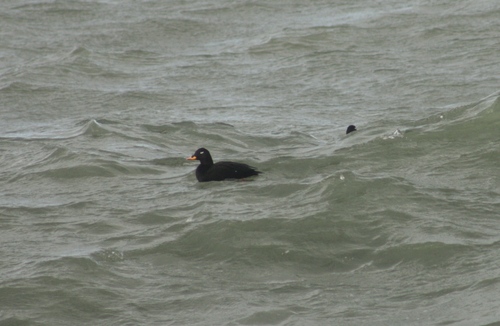


ID tip
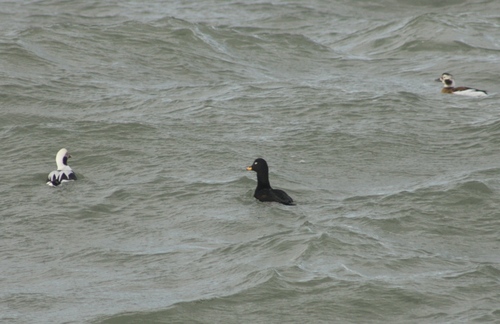
The velvet scoter is 51–56 cm (20–22 in) in length and has a wingspan of 90–99 cm (35–39 in). It is a relatively large sea duck with a thick neck, a long broad bill and a pointed tail. The plumage of the male is glossy black with large white wing patches and small white patches behind the eye. The bill is partly orange. The female is similar to the male but lacks the gloss on the feathers and is duller and browner.
Text from Wikipedia, licensed CC BY-SA 4.0.
When to see the Velvet Scoter
One bar for each month, and every month is filled: this bird is recorded here in all twelve. The wide bar is May, the month with the most records.
Where to see the Velvet Scoter
The map shades 41 countries with regular records, and 9 more in a lighter tone where the bird turns up only as a stray. Everything unshaded has no records. Countries are listed below the map.
Recorded as a rare visitor in Canada, South Korea, Morocco, Mongolia, Faroe Islands, Israel, Albania, Jersey, Luxembourg.
About the Velvet Scoter
The velvet scoter is a large sea duck, which breeds over the far north of Europe and the Palearctic west of the Yenisey basin. The genus name is derived from Ancient Greek melas "black" and netta "duck". The species name is from the Latin fuscus "dusky brown".
Text adapted from Wikipedia, licensed CC BY-SA 4.0.
Easily confused with
 Black ScoterMelanitta americanaThis large sea duck is characterised by its bulky shape and large bill.
 Common ScoterMelanitta nigraThe common scoter is characterised by its bulky shape and large bill.
 White-winged ScoterMelanitta deglandiThe white-winged scoter is one of three North American scoter species and the largest species of scoter.
Side by side: Velvet Scoter vs White-winged Scoter · Common Scoter vs Velvet Scoter · Black Scoter vs Velvet Scoter · Smew vs Velvet Scoter · Stejneger's Scoter vs Velvet Scoter
Learn the Velvet Scoter in the BeakBrain App
Photo and call practice. Coming soon to iPhone and Android.
Play today's Daily BirdEvery photo and recording on this page is credited to its author under the licence shown. Spotted a problem with this page, or have a better photo? Contribute.