Learn what every symbol on the card means.Full credits and sources at beakbrain.com/symbols
 GrasslandScrapeMedium · 159 g


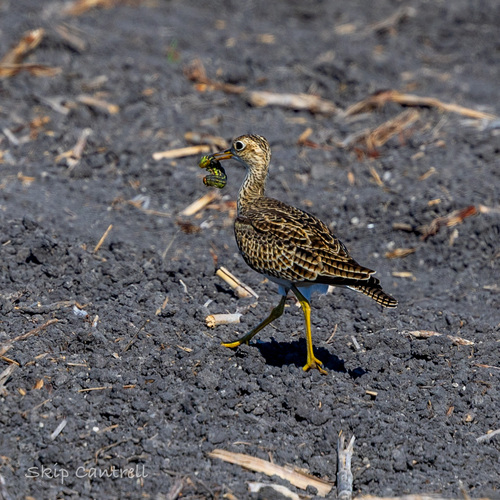
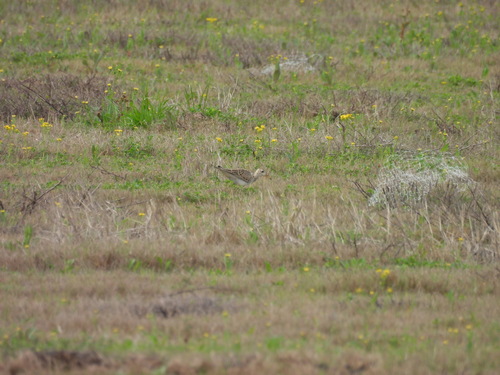
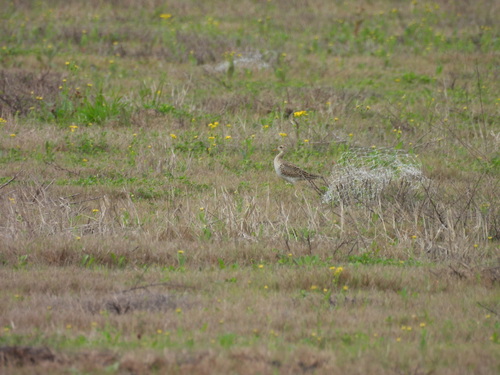
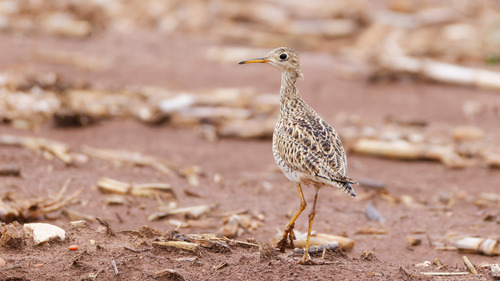
What the Upland Sandpiper sounds like


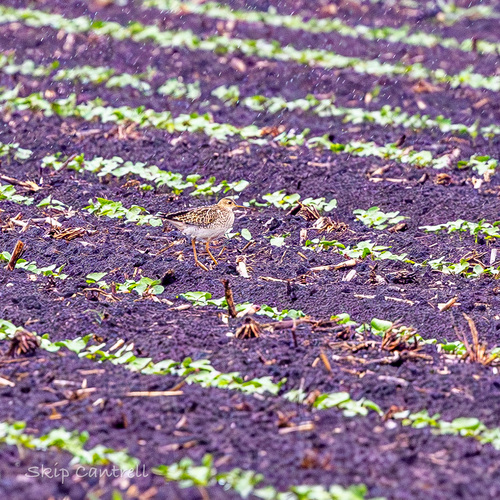
ID tip
An adult is roughly 30 cm (12 in) long with a 66 cm (26 in) wingspan. The average weight is 170 g (6 oz). This odd bird has a small dove-like head on a long neck. It is heavily marbled black and brown on the back and wings. The neck is streaked with dark brown which continues down to the breast and on to the flanks. The belly and undertail coverts are white, and the tail is quite long for a sandpiper. The upland sandpiper also has a white eye-ring and long yellow legs. Voice: Upland sandpipers can be identified by a distinctive call, sometimes called a "wolf whistle", which features a long, ascending whistle followed by a second rising and/or falling call. These sounds are often made while the bird is landing or while flying high.
Text from Wikipedia, licensed CC BY-SA 4.0.
When to see the Upland Sandpiper
One bar for each month. Filled bars are the 6 months with records; pale bars are months with none. The wide bar is May, the month with the most records.
Where to see the Upland Sandpiper
The map shades 41 countries with regular records, and 10 more in a lighter tone where the bird turns up only as a stray. Everything unshaded has no records. Countries are listed below the map.
Recorded as a rare visitor in France, Portugal, Norway, Spain, Finland, Ireland, Australia, Denmark, Dominica, St. Barthélemy.
About the Upland Sandpiper
The upland sandpiper is a large sandpiper, closely related to the curlews. Older names are the upland plover and Bartram's sandpiper. In Louisiana, it is also colloquially known as the papabotte. It is the sole extant member of the genus Bartramia. The genus name and the old common name Bartram's sandpiper commemorate the American naturalist William Bartram. The species name longicauda is from Latin longus, "long" and caudus, "tail". The name "Bartram's sandpiper" was made popular by Alexander Wilson, who was taught ornithology and natural history illustration by Bartram.
Text adapted from Wikipedia, licensed CC BY-SA 4.0.
Easily confused with
 Red-necked StintCalidris ruficollisThese birds are among the smallest of waders, very similar to the little stint, Calidris minuta, with which they were once considered conspecific.
 Red PhalaropePhalaropus fulicariusThe red phalarope is about 21 cm (8.3 in) in length, with lobed toes and a straight bill, somewhat thicker than that of red-necked phalarope.
 Sharp-tailed SandpiperCalidris acuminataA small-medium wader, the portly sandpiper has a pot belly, flat back and somewhat drawn-out rear end.
Side by side: Red-necked Stint vs Upland Sandpiper · Red Phalarope vs Upland Sandpiper · Sharp-tailed Sandpiper vs Upland Sandpiper
Learn the Upland Sandpiper in the BeakBrain App
Photo and call practice. Coming soon to iPhone and Android.
Play today's Daily BirdEvery photo and recording on this page is credited to its author under the licence shown. Spotted a problem with this page, or have a better photo? Contribute.