Learn what every symbol on the card means.Full credits and sources at beakbrain.com/symbols
 ForestCavity nestMedium · 111 g


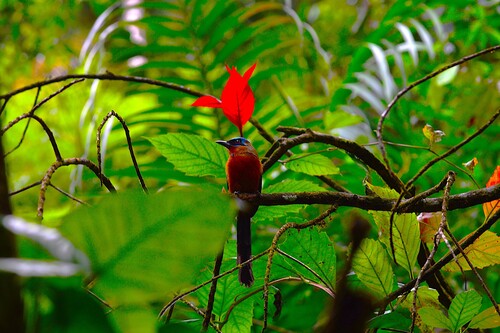


ID tip
The Trinidad motmot is much more deeply and uniformly rufous below than other species in Momotus. Its throat is a deep, intense reddish-brown, while its breast is slightly paler and often has a faint, lateral olive-green wash. These birds' abdomens are almost as dark as their breasts, and their thighs contrast sharply with their green or blue-green colouring. The contrast between the two is much stronger compared to other species. Their black pectoral feathers have broad and conspicuous turquoise borders, while the tibial feathers are green to blue-green. Voice: The Trinidad motmot's call is a low-pitched, owl-like "hoot" that can be described as a "coo-coo" or "ooo-doot." Unlike motmots with single-note calls, this species has a distinct two-note call. The first note is typically shorter and lower-pitched, with a noticeable drop in pitch at the end, while the second note is longer.
Text from Wikipedia, licensed CC BY-SA 4.0.
When to see the Trinidad Motmot
One bar for each month. Filled bars are the 10 months with records; pale bars are months with none. The wide bar is January, the month with the most records.
Where to see the Trinidad Motmot
The map shades 1 country with regular records. Everything unshaded has no records. Countries are listed below the map.
About the Trinidad Motmot
The Trinidad and Tobago motmot is a colourful Coraciiform afroavian endemic to the forests and woodlands of Trinidad and Tobago. It is a nonmigratory member of the Momotidae family and the Momotus genus. This species and the blue-capped motmot, Lesson's motmot, whooping motmot, Amazonian motmot, and Andean motmot were all considered conspecific. Though found on both islands, this bird is more abundant in Tobago than it is in Trinidad.
Text adapted from Wikipedia, licensed CC BY-SA 4.0.
Easily confused with
 Blue-capped MotmotMomotus coerulicepsThe blue-capped motmot or blue-crowned motmot, is a colorful near-passerine bird found in forests and woodlands of eastern Mexico.
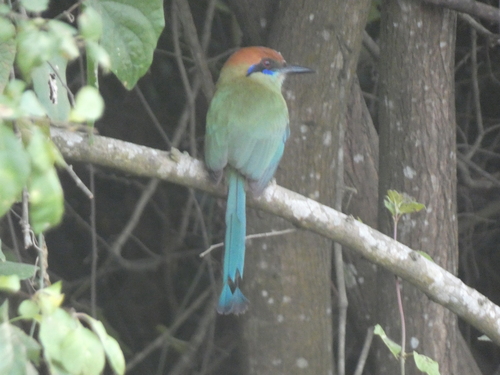 Russet-crowned MotmotMomotus mexicanusVoice: The russet-crowned motmot produces a low "krrp", "krrup", or "kru, krr-up" which is strung together, making a longer call.
 Whooping MotmotMomotus subrufescensThe whooping motmot's back and wings are olive-green and the underparts dull brown.
Side by side: Amazonian Motmot vs Trinidad Motmot · Trinidad Motmot vs Whooping Motmot · Russet-crowned Motmot vs Trinidad Motmot
Learn the Trinidad Motmot in the BeakBrain App
Photo and call practice. Coming soon to iPhone and Android.
Play today's Daily BirdEvery photo and recording on this page is credited to its author under the licence shown. Spotted a problem with this page, or have a better photo? Contribute.