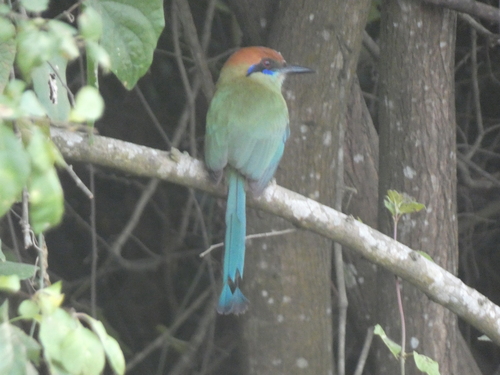
Russet-crowned Motmot
Momotus mexicanus
Voice: The russet-crowned motmot produces a low "krrp", "krrup", or "kru, krr-up" which is strung together, making a longer call. They can also produce a hollow "ook". Mated pairs take part in call-and-response duets.
ID text from Wikipedia, CC BY-SA 4.0

Trinidad Motmot
Momotus bahamensis
The Trinidad motmot is much more deeply and uniformly rufous below than other species in Momotus. Its throat is a deep, intense reddish-brown, while its breast is slightly paler and often has a faint, lateral olive-green wash. These birds' abdomens are almost as dark as their breasts, and their thighs contrast sharply with their green or blue-green colouring. The contrast between the two is much stronger compared to other species. Their black pectoral feathers have broad and conspicuous turquoise borders, while the tibial feathers are green to blue-green. Voice: The Trinidad motmot's call is a low-pitched, owl-like "hoot" that can be described as a "coo-coo" or "ooo-doot." Unlike motmots with single-note calls, this species has a distinct two-note call. The first note is typically shorter and lower-pitched, with a noticeable drop in pitch at the end, while the second note is longer.
ID text from Wikipedia, CC BY-SA 4.0
Learn this pair in the BeakBrain App
Photo and call practice. Coming soon to iPhone and Android.
Play today's Daily BirdPhotos and recordings are credited to their authors under the licence shown. Full profiles: Russet-crowned Motmot and Trinidad Motmot.