Learn what every symbol on the card means.Full credits and sources at beakbrain.com/symbols
 ForestCavity nestMedium · 98 g



What the Toucan Barbet sounds like

ID tip
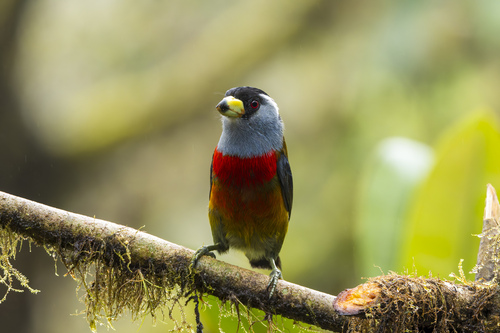
The toucan barbet is a medium-sized robust barbet, of 19 to 21 cm (7.5–8.3 in) long and weighing 80–115 g (2.8–4.1 oz). The beak is robust with a yellow maxilla and a light green mandible, both with dark ends. It is pronged at the end, though the prongs are not noticeable in the field. The plumage is colourful and includes a black crown, "mask", and thin cervical collar. The species has long occipital feathers and a conspicuous white stripe behind the eyes, which has a bright red-colored iris. The nape of the neck is golden-brown and becomes yellow towards the rump.
Text from Wikipedia, licensed CC BY-SA 4.0.
When to see the Toucan Barbet
One bar for each month, and every month is filled: this bird is recorded here in all twelve. The wide bar is February, the month with the most records.
Where to see the Toucan Barbet
The map shades 2 countries with regular records. Everything unshaded has no records. Countries are listed below the map.
About the Toucan Barbet
The toucan barbet is a barbet native to western Ecuador and Colombia. Along with the prong-billed barbet, it forms the family Semnornithidae, and is closely related to the toucans. It is a medium-sized barbet with a robust yellow bill. It has striking plumage, having a black head with grey throat and nape, red breast and upper belly, yellow lower belly and grey wings and tail.
Text adapted from Wikipedia, licensed CC BY-SA 4.0.
Easily confused with

Side by side: Prong-billed Barbet vs Toucan Barbet
Learn the Toucan Barbet in the BeakBrain App
Photo and call practice. Coming soon to iPhone and Android.
Play today's Daily BirdEvery photo and recording on this page is credited to its author under the licence shown. Spotted a problem with this page, or have a better photo? Contribute.