Learn what every symbol on the card means.Full credits and sources at beakbrain.com/symbols
 ForestPlatform nestLarge · 496 g

ID tip
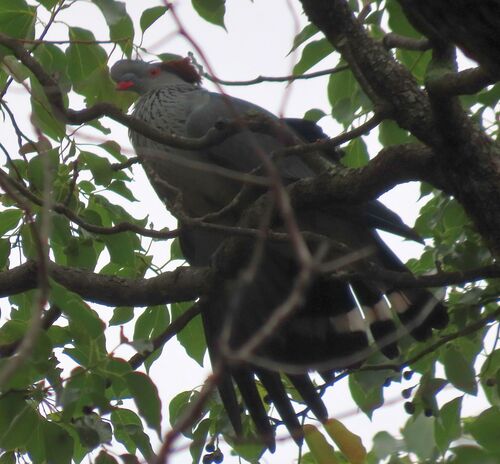
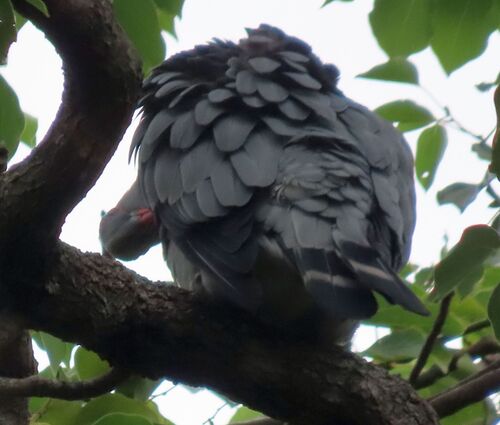
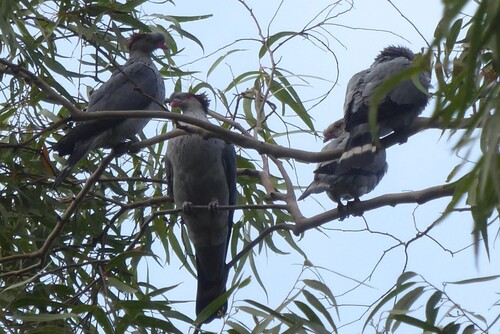
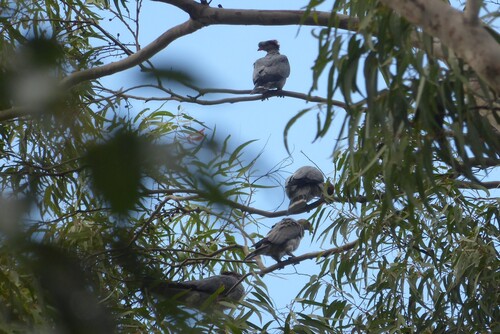
The topknot pigeon is a large predominately slate-grey bird, 40–46 centimetres (16–18 in) in length. The back, coverts and upper secondaries are a darker slate-grey with black quills. The primaries are black, the remaining body in a lighter slate-grey in colour. The chest and hind neck are notched, showing dark bases giving a streaked appearance. The tail is black crossed with a broad grey band. The crest is grey from the cere to the forehead, and russet brown on the crown with black sides. The mandibles are red with a brown tip, the protuberances at the base of the mandibles are bluish-green. Voice: Three distinct calls have been described. The first, 'coo-oo, eee', might be related to nestlings. The second, 'coo-oo, ooo', is distinctly louder but still soft. The third, 'cor-or', is "a quiet, croaky, almost guttural utterance", not unlike the call of the domestic pigeon. During times of flocking and mass feeding, this pigeon has a short raucous call.
Text from Wikipedia, licensed CC BY-SA 4.0.
When to see the Topknot Pigeon
One bar for each month, and every month is filled: this bird is recorded here in all twelve. The wide bar is October, the month with the most records.
Where to see the Topknot Pigeon
The map shades 1 country with regular records. Everything unshaded has no records. Countries are listed below the map.
About the Topknot Pigeon
The topknot pigeon is a pigeon native to eastern Australia.
Text adapted from Wikipedia, licensed CC BY-SA 4.0.
Easily confused with
 Wompoo Fruit DoveMegaloprepia magnificaThe wompoo fruit dove measures up to 45 cm (18 in) in overall length, but is generally far smaller in northern regions.
 Grey-chested DoveLeptotila cassiniiThe grey-chested dove is 22.5 to 28 cm (8.9 to 11.0 in) long and weighs 132 to 179 g (4.7 to 6.3 oz).
 Bare-eyed PigeonPatagioenas corensisMale bare-eyed pigeons are 32 to 37 cm (13 to 15 in) long and females 30 to 34.5 cm (11.8 to 13.6 in).
Side by side: Topknot Pigeon vs Wompoo Fruit Dove · Grey-chested Dove vs Topknot Pigeon · Bare-eyed Pigeon vs Topknot Pigeon
Learn the Topknot Pigeon in the BeakBrain App
Photo and call practice. Coming soon to iPhone and Android.
Play today's Daily BirdEvery photo and recording on this page is credited to its author under the licence shown. Spotted a problem with this page, or have a better photo? Contribute.