Learn what every symbol on the card means.Full credits and sources at beakbrain.com/symbols
 GrasslandScrapeLarge · 364 g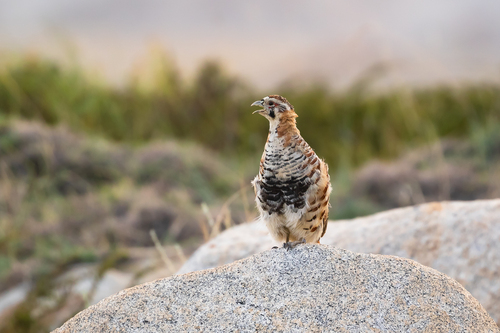
ID tip
Somewhat different in appearance from the other Perdix species such as the grey and Daurian partridges this 28–31 cm long partridge has the brown back, blackish belly patch and chestnut flanks of its relatives, but has a striking black and white face pattern, which contrasts with the rufous collar. The forehead, broad supercilium, face and throat are white. A broad black stripe runs down the face from below the eyes and it has a broad chestnut hind neck collar. The upper parts are buff, barred with rufous and black. The other tail-feathers are chestnut, tipped with white.
Text from Wikipedia, licensed CC BY-SA 4.0.
When to see the Tibetan Partridge
One bar for each month. Filled bars are the 9 months with records; pale bars are months with none. The wide bar is July, the month with the most records.
Where to see the Tibetan Partridge
The map shades 4 countries with regular records. Everything unshaded has no records. Countries are listed below the map.
About the Tibetan Partridge
The Tibetan partridge is a gamebird in the pheasant family Phasianidae of the order Galliformes. They are found widely across the Tibetan Plateau and have some variations in plumage across populations. They forage on the ground in the sparsely vegetated high altitude regions, moving in pairs during the summer and in larger groups during the non-breeding season. Neither males nor females have spurs on their legs.
Text adapted from Wikipedia, licensed CC BY-SA 4.0.
Easily confused with


Learn the Tibetan Partridge in the BeakBrain App
Photo and call practice. Coming soon to iPhone and Android.
Play today's Daily BirdEvery photo and recording on this page is credited to its author under the licence shown. Spotted a problem with this page, or have a better photo? Contribute.