Learn what every symbol on the card means.Full credits and sources at beakbrain.com/symbols
 ShrublandPlatform nestHuge · 2.2 kg


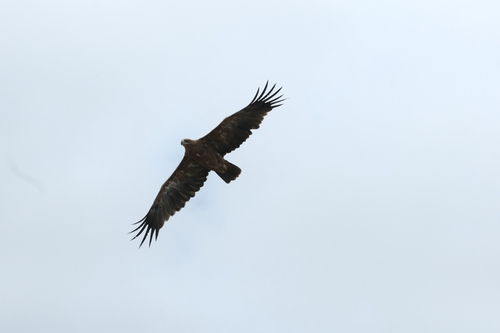
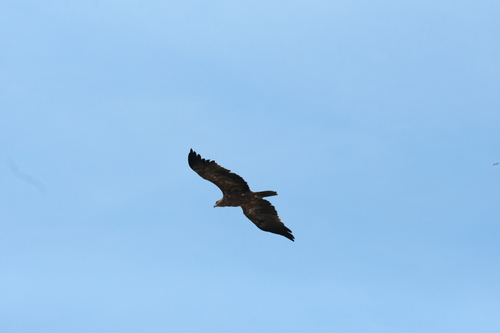
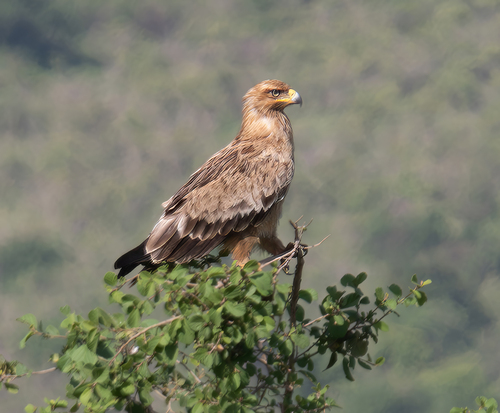

ID tip
The tawny eagle is considered to appear "inelegant, scruffy-looking" but has a fairly characteristic aquiline silhouette. The species has a fairly long neck and long deep bill with a gape line level with the eye, moderately long wings with fairly pronounced "fingers" and a slightly rounded to almost square-ended and shortish tail, which can be more reminiscent of the tail of a vulture than that of other eagles. The feathering on the legs is extensive and can appear almost baggy-looking. Voice: Tawny eagles are generally silent in most of their range. However, unlike steppe eagles, which are almost always silent away from their breeding grounds, they are said to occasionally vocalize in any season. They are also more vocal when not breeding than the spotted eagles. The usual call is a harsh, hollow-sounding, loud bark, variously transcribed as kowk-kowk, kau-kau, kiok-kiok or ki-ark.
Text from Wikipedia, licensed CC BY-SA 4.0.
When to see the Tawny Eagle
One bar for each month, and every month is filled: this bird is recorded here in all twelve. The wide bar is November, the month with the most records.
Where to see the Tawny Eagle
The map shades 42 countries with regular records, and 3 more in a lighter tone where the bird turns up only as a stray. Everything unshaded has no records. Countries are listed below the map.
About the Tawny Eagle
The tawny eagle is a large bird of prey. Like all eagles, it belongs to the family Accipitridae. Its heavily feathered legs mark it as a member of the subfamily Aquilinae, also known as booted eagles. Tawny eagles have an extensive but discontinuous breeding range that constitutes much of the African continent as well as the Indian subcontinent, with rare residency in the southern Middle East. Throughout its range, it favours open dry habitats such as semideserts, deserts steppes, or savanna plains. Despite its preference for arid areas, the species seldom occurs in areas where trees are entirely absent.
Text adapted from Wikipedia, licensed CC BY-SA 4.0.
Easily confused with
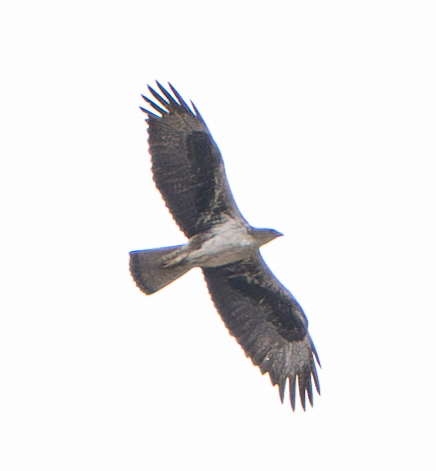 Bonelli's EagleAquila fasciataVoice: Bonelli's eagle is largely silent outside of breeding season and is a somewhat infrequent vocalizer even in the context of breeding.
 Steppe EagleAquila nipalensisThe steppe eagle is a large, bulky and robust-looking eagle.
 Eastern Imperial EagleAquila heliacaThe eastern imperial eagle is a large eagle, but usually falls near the average size of the large-bodied genus Aquila.
Side by side: Golden Eagle vs Tawny Eagle · Tawny Eagle vs Wedge-tailed Eagle · Bonelli's Eagle vs Tawny Eagle · Steppe Eagle vs Tawny Eagle · Eastern Imperial Eagle vs Tawny Eagle
Learn the Tawny Eagle in the BeakBrain App
Photo and call practice. Coming soon to iPhone and Android.
Play today's Daily BirdEvery photo and recording on this page is credited to its author under the licence shown. Spotted a problem with this page, or have a better photo? Contribute.