Learn what every symbol on the card means.Full credits and sources at beakbrain.com/symbols
 WoodlandCavity nestTiny · 11 g


What the Taiga Flycatcher sounds like

When to see the Taiga Flycatcher
One bar for each month. Filled bars are the 8 months with records; pale bars are months with none. The wide bar is February, the month with the most records.
Where to see the Taiga Flycatcher
The map shades 23 countries with regular records, and 10 more in a lighter tone where the bird turns up only as a stray. Everything unshaded has no records. Countries are listed below the map.
Recorded as a rare visitor in United States, United Kingdom, Norway, Germany, Canada, Finland, Denmark, Sweden, Azerbaijan, Ireland.
About the Taiga Flycatcher
The taiga flycatcher or red-throated flycatcher is a migratory bird in the family Muscicapidae. The species was first described by Peter Simon Pallas in 1811. The female has brown upper parts with a blackish tail flanked by white. The breast is buffish with underparts mostly white. The male has ear coverts and sides of the neck blue-tinged grey with breeding males having orange-red coloration on the throats. Unlike the taiga flycatcher, the female of the similar red-breasted flycatcher has a brown tail while the red colour in breeding males extends to the breast in the red-breasted flycatcher. It breeds in northern Eurasia from eastern Russia to Siberia and Mongolia.
Text adapted from Wikipedia, licensed CC BY-SA 4.0.
Easily confused with
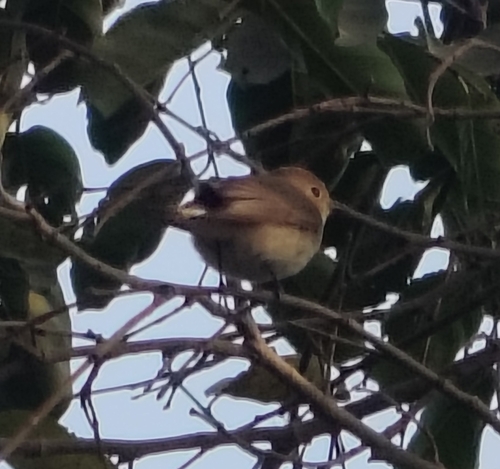 Red-breasted FlycatcherFicedula parvaAt 11–12 cm long, this is a relatively small flycatcher, only slightly larger than the Eurasian wren.
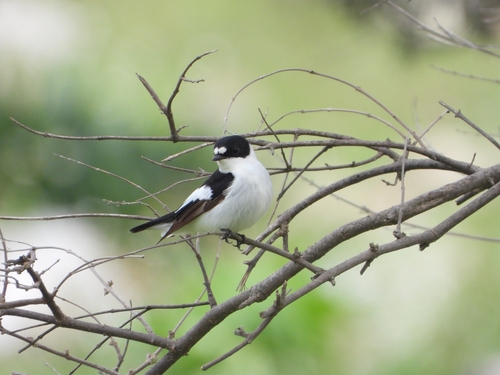 Collared FlycatcherFicedula albicollisThe collared flycatcher is a small passerine bird in the Old World flycatcher family, one of the four species of Western Palearctic black-and-white flycatchers.
 Little Pied FlycatcherFicedula westermanniThe little pied flycatcher is a species of bird in the family Muscicapidae.
Learn the Taiga Flycatcher in the BeakBrain App
Photo and call practice. Coming soon to iPhone and Android.
Play today's Daily BirdEvery photo and recording on this page is credited to its author under the licence shown. Spotted a problem with this page, or have a better photo? Contribute.