Learn what every symbol on the card means.Full credits and sources at beakbrain.com/symbols
 MarinePlatform nestLarge · 687 g


ID tip
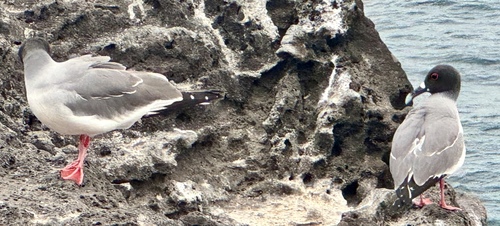
The swallow-tailed gull has no structural or plumage differences between the male and female. In the breeding season, the adult has a black plumaged head and a bright red fleshy rim around each eye. Outside the breeding season, the head is white and the eye rim becomes black. It has a grayish upper breast, gray mantle, and black wingtips. The mostly black bill has a contrasting white tip. Voice: Calls and displays are quite different from other gulls, most resembling the vocalisations of the black-legged kittiwake and Sabine's gull. The loudest and most commonly heard call is an alarm referred to as "rattle-and-whistle", a gurgling scream made with the head moving side to side. This call is contagious, with other birds joining in without seeing the cause.
Text from Wikipedia, licensed CC BY-SA 4.0.
When to see the Swallow-tailed Gull
One bar for each month, and every month is filled: this bird is recorded here in all twelve. The wide bar is June, the month with the most records.
Where to see the Swallow-tailed Gull
The map shades 5 countries with regular records, and 4 more in a lighter tone where the bird turns up only as a stray. Everything unshaded has no records. Countries are listed below the map.
Recorded as a rare visitor in United States, Mexico, Panama, Guatemala.
About the Swallow-tailed Gull
The swallow-tailed gull is an equatorial seabird in the gull family, Laridae. It is the only species in the genus Creagrus, which derives from the Latin Creagra and the Greek kreourgos which means butcher, also from kreas, meat; according to Jobling it would mean "hook for meat" referring to the hooked bill of this species. It was first described by French naturalist and surgeon Adolphe-Simon Neboux in 1846. Its scientific name is originally derived from the Greek word for gull, "Glaros" and via Latin Larus, "gull" and furca "two-tined fork". It spends most of its life flying and hunting over the open ocean.
Text adapted from Wikipedia, licensed CC BY-SA 4.0.
Easily confused with
 Aleutian TernOnychoprion aleuticusThe Aleutian tern is medium-sized tern (32–39 cm (13–15 in) long), with a 75–80 cm (30–31 in) wingspan, a short pointed bill and a long, deeply forked tail.
 Sooty GullIchthyaetus hemprichiiThe sooty gull is a species of gull in the family Laridae, also known as the Aden gull or Hemprich's gull.
 Saunders's GullSaundersilarus saundersiThis is a very small species of gull with a length of just 33 cm (13 in) and, among gulls, only the little gull is smaller.
Side by side: Saunders's Gull vs Swallow-tailed Gull · Aleutian Tern vs Swallow-tailed Gull
Learn the Swallow-tailed Gull in the BeakBrain App
Photo and call practice. Coming soon to iPhone and Android.
Play today's Daily BirdEvery photo and recording on this page is credited to its author under the licence shown. Spotted a problem with this page, or have a better photo? Contribute.