Learn what every symbol on the card means.Full credits and sources at beakbrain.com/symbols
 WetlandScrapeLarge · 1.1 kg



ID tip
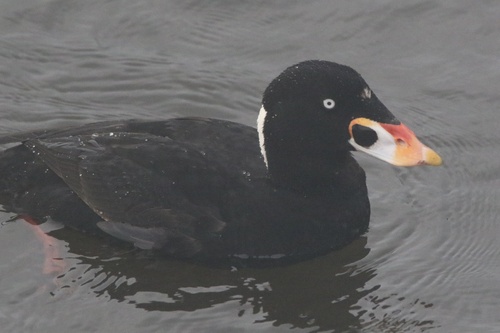
The surf scoter reaches sexual maturity after 3 years. The adult male is on average 1,050 g (2.31 lb) and 48 cm (19 in) in length while the adult female averages about 900 g (2.0 lb) and 44 cm (17 in) in length, making this the smallest species of scoter on average. The surf scoter has a wingspan of 29.9–30.3 in (76–77 cm). The male is completely velvety black except for white patches on the forehead and the nape. It has a swollen bill, appearing orange at a distance but patterned with white, red and yellow, and a black spot near the base. Voice: Surf scoters are generally silent and their few vocalizations are poorly known. During courtship display, males perform a gurgling call and an explosive puk-puk. Females defend their young with a crowlike call. When alarmed, surf scoters will often make a sound like a "guk", somewhere between a "cluck" and a "tok", while rapidly surveying their environment or taking to flight en masse.
Text from Wikipedia, licensed CC BY-SA 4.0.
When to see the Surf Scoter
One bar for each month. Filled bars are the 9 months with records; pale bars are months with none. The wide bar is January, the month with the most records.
Where to see the Surf Scoter
The map shades 17 countries with regular records, and 7 more in a lighter tone where the bird turns up only as a stray. Everything unshaded has no records. Countries are listed below the map.
Recorded as a rare visitor in France, Belgium, Finland, Netherlands, Japan, Germany, South Korea.
About the Surf Scoter
The surf scoter is a large sea duck native to North America. Adult males are almost entirely black with characteristic white patches on the forehead and the nape and adult females are slightly smaller and browner. Surf scoters breed in Northern Canada and Alaska and winter along the Pacific and Atlantic coasts of North America. They are diving ducks and mainly feed on benthic invertebrates, mussels representing an important part of their diet.
Text adapted from Wikipedia, licensed CC BY-SA 4.0.
Easily confused with
 White-winged ScoterMelanitta deglandiThe white-winged scoter is one of three North American scoter species and the largest species of scoter.
 Common ScoterMelanitta nigraThe common scoter is characterised by its bulky shape and large bill.
 Black ScoterMelanitta americanaThis large sea duck is characterised by its bulky shape and large bill.
Side by side: Long-tailed Duck vs Surf Scoter · Egyptian Goose vs Surf Scoter · Surf Scoter vs White-winged Scoter · Common Scoter vs Surf Scoter · Black Scoter vs Surf Scoter
Learn the Surf Scoter in the BeakBrain App
Photo and call practice. Coming soon to iPhone and Android.
Play today's Daily BirdEvery photo and recording on this page is credited to its author under the licence shown. Spotted a problem with this page, or have a better photo? Contribute.