Learn what every symbol on the card means.Full credits and sources at beakbrain.com/symbols
 ForestCavity nestMedium · 142 g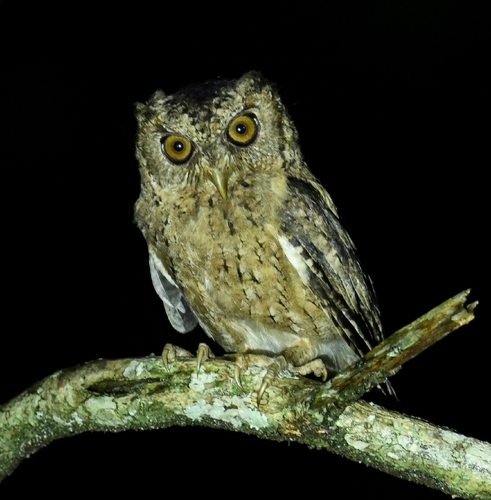
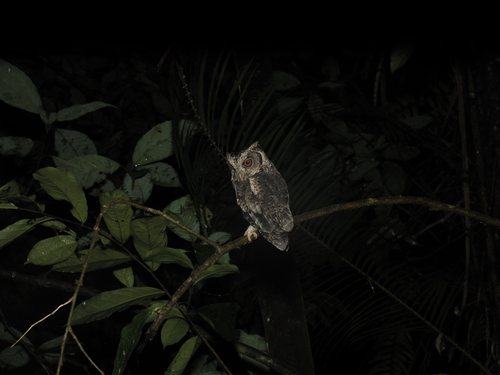
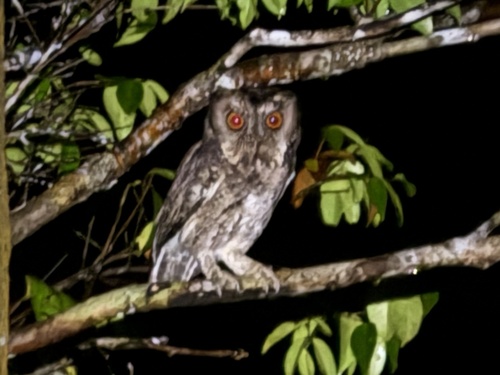
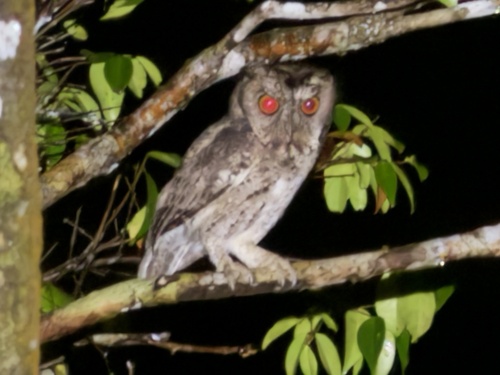
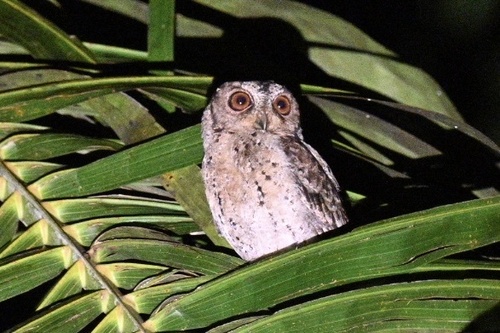


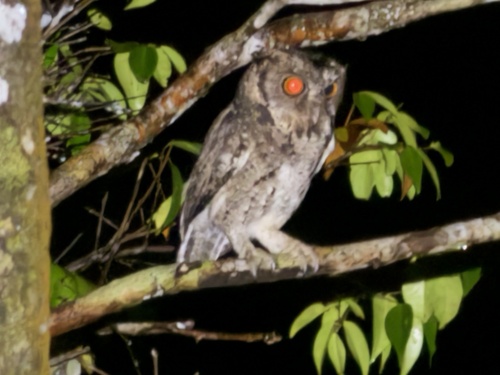
ID tip
It grows from 20 to 25 cm (7.9 to 9.8 in) and can weigh 100 to 170 g (3.5 to 6.0 oz). It is speckled with black on the upper parts and streaked with black on the lower parts. It has a light collar and dark eyes, which differentiate it from the reddish scops, mountain scops, Oriental scops and Rajah scops owls. Voice: Its call is a hooting yelp in between a longer period of silence. Sunda scops owls use their callings to mark their territory and have evolved to have voice individuality to improve their territory proclamation. Every owl has its own unique vocal characteristics such as varying frequencies at which they produce their callings/noises which gives them each a unique voice.
Text from Wikipedia, licensed CC BY-SA 4.0.
When to see the Sunda Scops Owl
One bar for each month. Filled bars are the 11 months with records; pale bars are months with none. The wide bar is July, the month with the most records.
Where to see the Sunda Scops Owl
The map shades 3 countries with regular records, and 2 more in a lighter tone where the bird turns up only as a stray. Everything unshaded has no records. Countries are listed below the map.
About the Sunda Scops Owl
The Sunda scops owl is a small brown owl native to the Sunda Islands.
Text adapted from Wikipedia, licensed CC BY-SA 4.0.
Easily confused with
 Mantanani Scops OwlOtus mantananensisThe Mantanani scops owl, is a small owl in the scops-owl genus Otus found on small islands between Borneo and the Philippines.
 Sokoke Scops OwlOtus ireneaeSokoke scops owl is a fairly plain scops owl with small spotted markings on the underside.
 Japanese Scops OwlOtus semitorquesJapanese scops-owls are 16.5–30 cm (6.5–11.8 in) tall, and their wingspan is 60–66 cm (23.5–26 in).
Learn the Sunda Scops Owl in the BeakBrain App
Photo and call practice. Coming soon to iPhone and Android.
Play today's Daily BirdEvery photo and recording on this page is credited to its author under the licence shown. Spotted a problem with this page, or have a better photo? Contribute.