Learn what every symbol on the card means.Full credits and sources at beakbrain.com/symbols
 ShrublandCavity nestSmall · 43 g


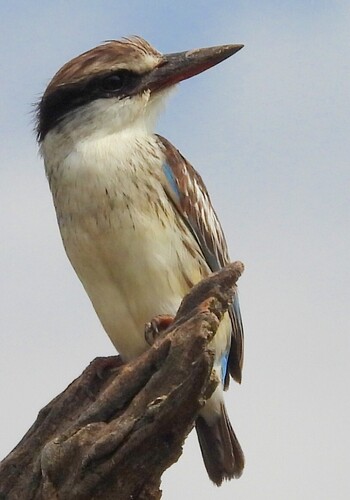
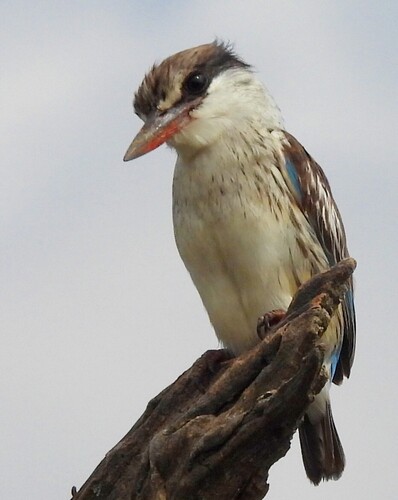
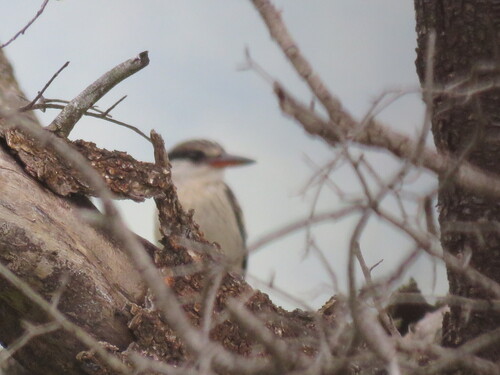

What the Striped Kingfisher sounds like

ID tip
The striped kingfisher of the nominate subspecies H. c. chelicuti averages 16 to 18 cm (about 6.5 in) from beak to tail. Perched adults look mostly greyish brown on the upper part of the body. The lower back, secondary flight feathers, and tail are metallic blue; this colour is much more visible when the bird flies than when it is perched, as is a white patch at the base of the primary flight feathers. The wing linings are white with a black border, and in males a black bar at the base of the primaries.
Text from Wikipedia, licensed CC BY-SA 4.0.
When to see the Striped Kingfisher
One bar for each month, and every month is filled: this bird is recorded here in all twelve. The wide bar is November, the month with the most records.
Where to see the Striped Kingfisher
The map shades 34 countries with regular records, and 2 more in a lighter tone where the bird turns up only as a stray. Everything unshaded has no records. Countries are listed below the map.
About the Striped Kingfisher
The striped kingfisher is a species of bird in the tree kingfisher subfamily. It was first described by Edward, Lord Stanley, in Salt's Voyage to Abyssinia in 1814 as "Chelicut kingfisher" Alaudo Chelicuti.
Text adapted from Wikipedia, licensed CC BY-SA 4.0.
Easily confused with
 Grey-headed KingfisherHalcyon leucocephalaThe sexes are similar.
 Black-capped KingfisherHalcyon pileataThis kingfisher is about 28 centimetres (11 in) long.
 Blue-breasted KingfisherHalcyon malimbicaThe blue-breasted kingfisher is a tree kingfisher widely distributed across Equatorial Africa.
Side by side: Striped Kingfisher vs White-throated Kingfisher · Brown-hooded Kingfisher vs Striped Kingfisher · Striped Kingfisher vs Woodland Kingfisher · Grey-headed Kingfisher vs Striped Kingfisher · Black-capped Kingfisher vs Striped Kingfisher
Learn the Striped Kingfisher in the BeakBrain App
Photo and call practice. Coming soon to iPhone and Android.
Play today's Daily BirdEvery photo and recording on this page is credited to its author under the licence shown. Spotted a problem with this page, or have a better photo? Contribute.