Learn what every symbol on the card means.Full credits and sources at beakbrain.com/symbols
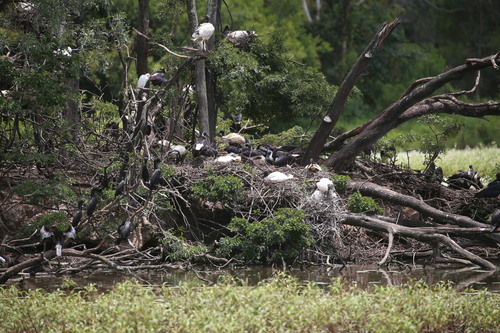
 GrasslandPlatform nestLarge · 1.3 kg




ID tip
Straw-necked ibises are large birds, around 59–76 cm (23–30 in) long, with a bare black head and a long, downcurved black bill. They have a distinctive, highly iridescent plumage, which can appear fairly uniform dirty dark brown in indifferent light; the wings are dark, with an iridescent, multicoloured sheen in sunlight. They have a shiny blue-black back, with a metallic purple, green and bronze glow, and a dark collar. The upper neck is white, as are the underparts and the undertail; their legs are usually red near the top and dark grey toward the feet.
Text from Wikipedia, licensed CC BY-SA 4.0.
When to see the Straw-necked Ibis
One bar for each month, and every month is filled: this bird is recorded here in all twelve. The wide bar is October, the month with the most records.
Where to see the Straw-necked Ibis
The map shades 3 countries with regular records, and 2 more in a lighter tone where the bird turns up only as a stray. Everything unshaded has no records. Countries are listed below the map.
Recorded as a rare visitor in New Zealand, Germany.
About the Straw-necked Ibis
The straw-necked ibis is a bird of the ibis and spoonbill family Threskiornithidae. It can be found throughout Australia, New Guinea, and parts of Indonesia. Adults have distinctive straw-like feathers on their necks.
Text adapted from Wikipedia, licensed CC BY-SA 4.0.
Easily confused with
 African Sacred IbisThreskiornis aethiopicusAn adult individual is 68 cm (27 in) long with all-white body plumage apart from dark plumes on the rump.
 Black-headed IbisThreskiornis melanocephalusThe black-headed ibis is one of several large waterbird species in south and south-east Asia, with adults measuring 65–76 cm in length.
 Malagasy Sacred IbisThreskiornis bernieriThe adult stands 65–89 cm (26–35 in) tall, with a wingspan of 112–124 cm (44–49 in).
Side by side: Australian White Ibis vs Straw-necked Ibis · African Sacred Ibis vs Straw-necked Ibis · Black-headed Ibis vs Straw-necked Ibis · Bare-faced Ibis vs Straw-necked Ibis
Learn the Straw-necked Ibis in the BeakBrain App
Photo and call practice. Coming soon to iPhone and Android.
Play today's Daily BirdEvery photo and recording on this page is credited to its author under the licence shown. Spotted a problem with this page, or have a better photo? Contribute.