Learn what every symbol on the card means.Full credits and sources at beakbrain.com/symbols
 ForestCup nestMedium · 128 g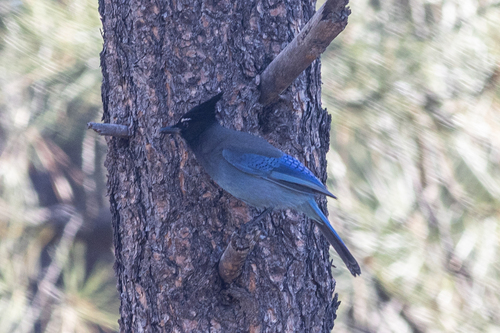


What the Steller's Jay sounds like


ID tip
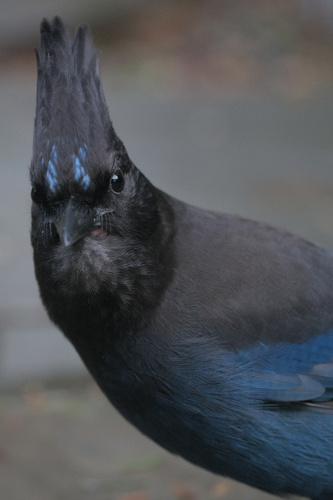
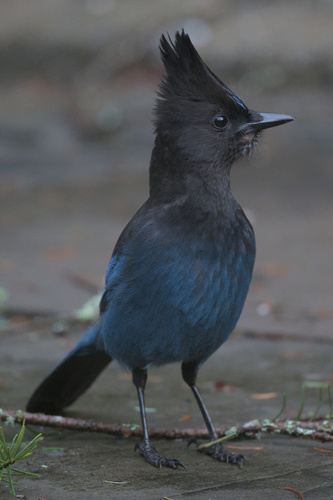
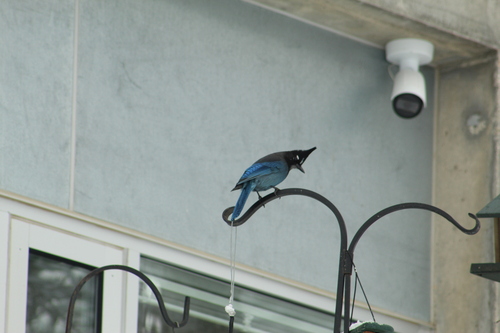
Steller's jay is about 30–34 cm (12–13 in) long and weighs about 100–140 g (3.5–4.9 oz). Steller's jay shows a great deal of regional variation throughout its range. Blackish-brown-headed birds from the north gradually become bluer-headed farther south. Steller's jay has a more slender bill and longer legs than the blue jay and, in northern populations, has a much more pronounced crest. It is also somewhat larger than the blue jay's. The head is blackish-brown, black, or dark blue, depending on the subspecies of the bird, with lighter streaks on the forehead. Voice: Like other jays, Steller's jay has numerous and variable vocalizations. One common call is a harsh "SHACK-Sheck-sheck-sheck-sheck-sheck" series; another "skreeka! skreeka!" call sounds almost exactly like an old-fashioned pump handle; yet another is a soft, breathy "hoodle hoodle" whistle. Its alarm call is a harsh, nasal "wah".
Text from Wikipedia, licensed CC BY-SA 4.0.
When to see the Steller's Jay
One bar for each month, and every month is filled: this bird is recorded here in all twelve. The wide bar is May, the month with the most records.
Where to see the Steller's Jay
The map shades 7 countries with regular records. Everything unshaded has no records. Countries are listed below the map.
About the Steller's Jay
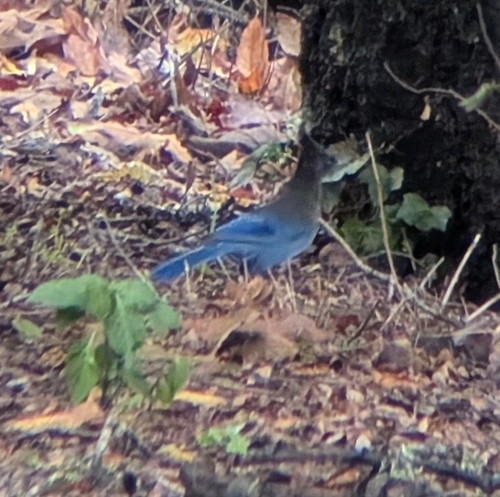
Steller's jay is a bird native to western North America and the mountains of Central America, closely related to the blue jay found in eastern North America. It is the only crested jay west of the Rocky Mountains. It is also sometimes colloquially called a "blue jay" in the Pacific Northwest, but is distinct from the blue jay of eastern North America. The species inhabits pine-oak and coniferous forests.
Text adapted from Wikipedia, licensed CC BY-SA 4.0.
Easily confused with
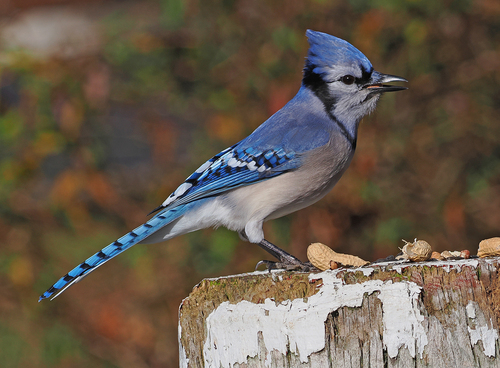
Side by side: Blue Jay vs Steller's Jay
Learn the Steller's Jay in the BeakBrain App
Photo and call practice. Coming soon to iPhone and Android.
Play today's Daily BirdEvery photo and recording on this page is credited to its author under the licence shown. Spotted a problem with this page, or have a better photo? Contribute.