Learn what every symbol on the card means.Full credits and sources at beakbrain.com/symbols
 WoodlandCup nestMedium · 88 g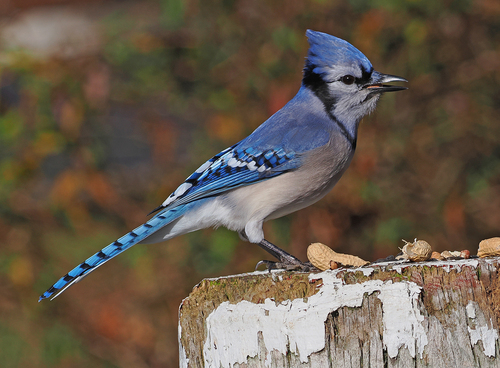


What the Blue Jay sounds like


ID tip
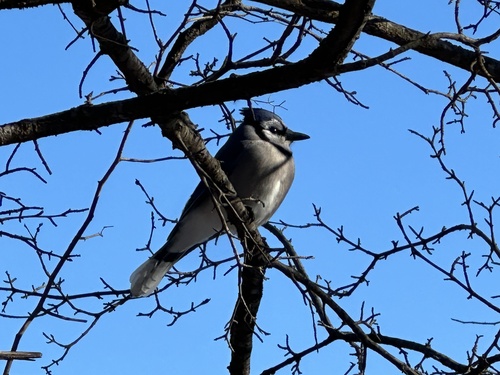
The blue jay measures 22–30 cm (9–12 in) from bill to tail and weighs 70–100 g (2.5–3.5 oz), with a wingspan of 34–43 cm (13–17 in). Consistent with Bergmann's rule, jays from Connecticut averaged 92.4 g (3.26 oz) in weight, while jays from warmer southern Florida averaged 73.7 g (2.60 oz). There is a pronounced crest on the head, a crown of feathers, which may be raised or lowered according to the bird's mood. When excited or aggressive, the crest will be fully raised. When frightened, the crest bristles outwards, brushlike. Voice: Blue jays can make a large variety of sounds, and individuals may vary perceptibly in their calling style. Like other corvids, they may learn to mimic human speech. Blue jays can also copy the cries of local hawks so well that it is sometimes difficult to tell which it is.
Text from Wikipedia, licensed CC BY-SA 4.0.
When to see the Blue Jay
One bar for each month, and every month is filled: this bird is recorded here in all twelve. The wide bar is May, the month with the most records.
Where to see the Blue Jay
The map shades 3 countries with regular records, and 1 more in a lighter tone where the bird turns up only as a stray. Everything unshaded has no records. Countries are listed below the map.
Recorded as a rare visitor in United Kingdom.
About the Blue Jay
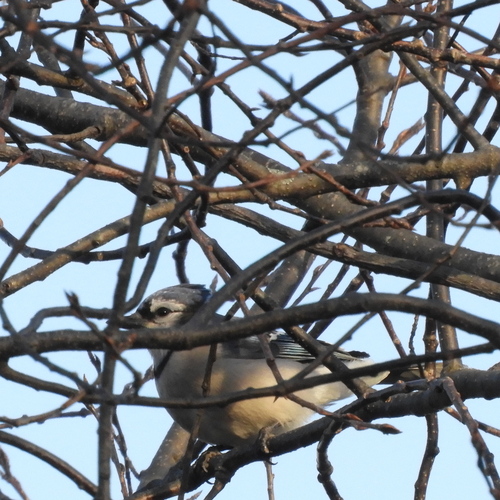
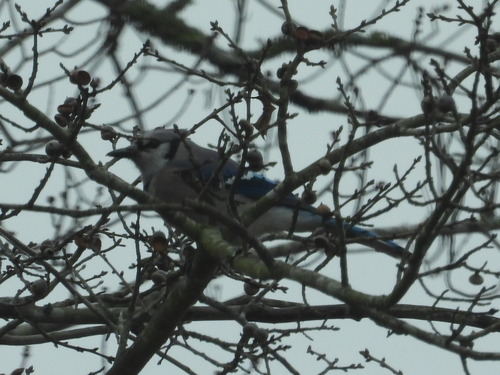
The blue jay is a passerine bird in the family Corvidae, native to eastern North America. It lives in most of the eastern and central United States; some eastern populations may be migratory. Resident populations are also in Newfoundland, Canada; breeding populations are found across southern Canada. It breeds in both deciduous and coniferous forests, and is common in residential areas. Its coloration is predominantly blue, with a white chest and underparts, and a blue crest; it has a black, U-shaped collar around its neck and a black border behind the crest. Males and females are similar in size and plumage, which does not vary throughout the year. Four subspecies have been recognized.
Text adapted from Wikipedia, licensed CC BY-SA 4.0.
Easily confused with
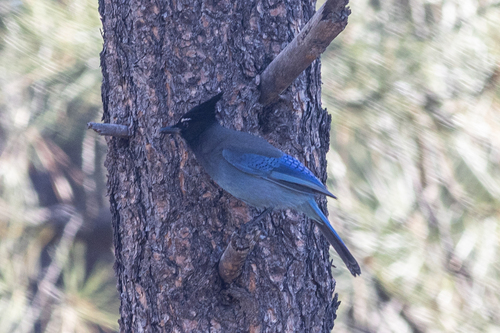
Side by side: Blue Jay vs Steller's Jay
Watch the Blue Jay on live cams
Browse all 118 bird cams worldwide, live and seasonal, by region and species.
Learn the Blue Jay in the BeakBrain App
Photo and call practice. Coming soon to iPhone and Android.
Play today's Daily BirdEvery photo and recording on this page is credited to its author under the licence shown. Spotted a problem with this page, or have a better photo? Contribute.