Learn what every symbol on the card means.Full credits and sources at beakbrain.com/symbols
 GrasslandScrapeSmall · 48 g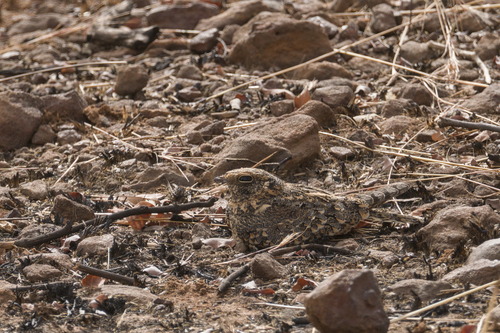
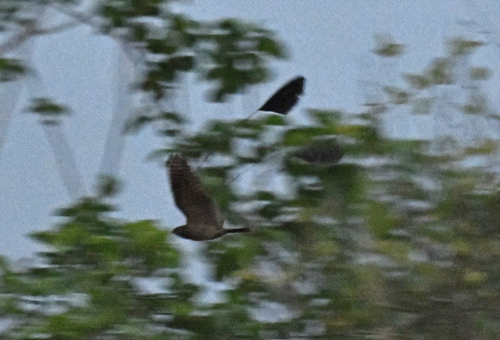


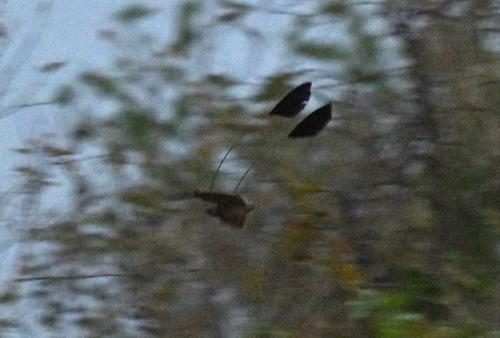
ID tip
When roosting on the ground during the day, this medium-sized (20–23 centimetres (7.9–9.1 in) long) nightjar is mainly variegated grey, with a browner collar. It has a shadowy form with easy, silent moth-like flight; this nightjar is relatively short-tailed, and lacks white in the wings or tail. The song is a churring trill. The adult male grows ornamental feathers during the breeding season which consists of a broad secondary flight feather on each wing elongated to up to 53.5 centimetres (21.1 in), over twice the length of the bird's body.
Text from Wikipedia, licensed CC BY-SA 4.0.
When to see the Standard-winged Nightjar
One bar for each month. Filled bars are the 7 months with records; pale bars are months with none. The wide bar is January, the month with the most records.
Where to see the Standard-winged Nightjar
The map shades 19 countries with regular records, and 1 more in a lighter tone where the bird turns up only as a stray. Everything unshaded has no records. Countries are listed below the map.
Recorded as a rare visitor in Mali.
About the Standard-winged Nightjar
The standard-winged nightjar is a nocturnal bird in the nightjar family. Previously placed with the pennant-winged nightjar in their own genus, Macrodipteryx, it is native to Africa and displays extreme sexual dimorphism. During the breeding season, males will grow broad ornamental flight feathers longer than their body.
Text adapted from Wikipedia, licensed CC BY-SA 4.0.
Easily confused with
 Pennant-winged NightjarCaprimulgus vexillariusThe male of the species is characteristic in having a broad white band over the otherwise black primaries.
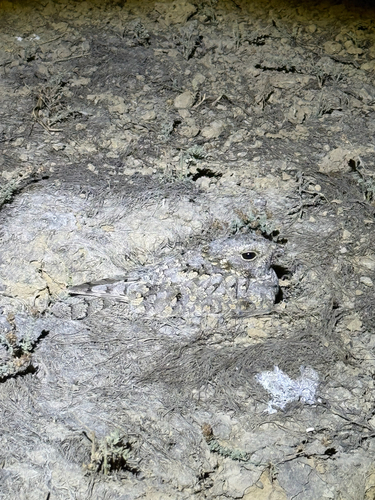 Sykes's NightjarCaprimulgus mahrattensisThe Sykes's nightjar is a relatively small bird, measuring around 20-25 centimeters in length and weighing about 60 grams.
Andaman NightjarCaprimulgus andamanicusThe Andaman nightjar is a species of nightjar found in the Andaman Islands.
Sykes's NightjarCaprimulgus mahrattensisThe Sykes's nightjar is a relatively small bird, measuring around 20-25 centimeters in length and weighing about 60 grams.
Andaman NightjarCaprimulgus andamanicusThe Andaman nightjar is a species of nightjar found in the Andaman Islands.
Learn the Standard-winged Nightjar in the BeakBrain App
Photo and call practice. Coming soon to iPhone and Android.
Play today's Daily BirdEvery photo and recording on this page is credited to its author under the licence shown. Spotted a problem with this page, or have a better photo? Contribute.