Learn what every symbol on the card means.Full credits and sources at beakbrain.com/symbols
 WoodlandPlatform nestSmall · 52 g


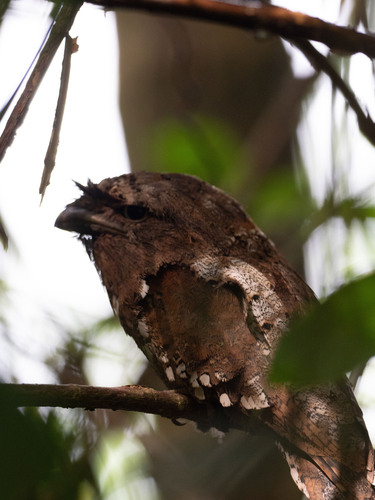
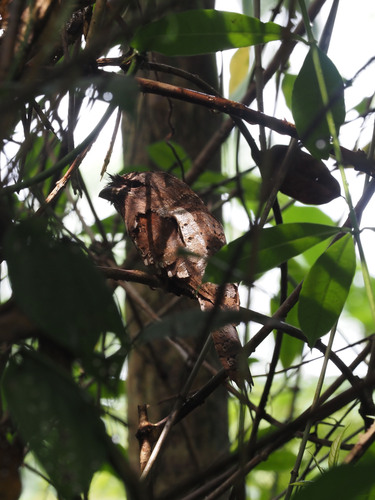

ID tip
This bird reaches 23 centimetres (9.1 in) in length. Like all frogmouths, this species has a wide and hooked bill with slit-like nostrils and the large head with eyes facing forward to provide a wide field of binocular vision. Compared to others of its genus it has small wings, which are distinguished by the wing coverts ending in black spots tipped with white. The male is gray-brown with fine barring and a spotted crown. Some males are browner and look more similar to females. The female is more rufous or chestnut brown.
Text from Wikipedia, licensed CC BY-SA 4.0.
When to see the Sri Lanka Frogmouth
One bar for each month. Filled bars are the 9 months with records; pale bars are months with none. The wide bar is January, the month with the most records.
Where to see the Sri Lanka Frogmouth
The map shades 2 countries with regular records. Everything unshaded has no records. Countries are listed below the map.
About the Sri Lanka Frogmouth
The Sri Lanka frogmouth, Sri Lankan frogmouth or Ceylon frogmouth is a small frogmouth found in the Western Ghats of south India and Sri Lanka. Related to the nightjars, it is nocturnal and is found in forest habitats. The plumage coloration resembles that of dried leaves and the bird roosts quietly on branches, making it difficult to see. Each has a favourite roost that it uses regularly unless disturbed. It has a distinctive call that is usually heard at dawn and dusk. The sexes differ slightly in plumage.
Text adapted from Wikipedia, licensed CC BY-SA 4.0.
Easily confused with
 Blyth's FrogmouthBatrachostomus affinisBlyth’s frogmouth is a small to medium species that measures between 20 and 23 centimeters in length.
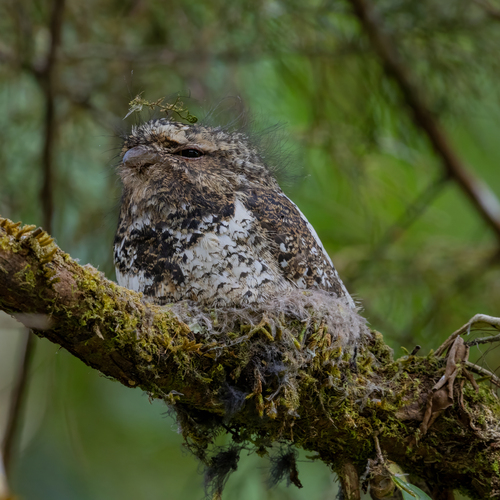 Hodgson's FrogmouthBatrachostomus hodgsoniHodgson's frogmouth is one of the smaller members of the family Podargidae.
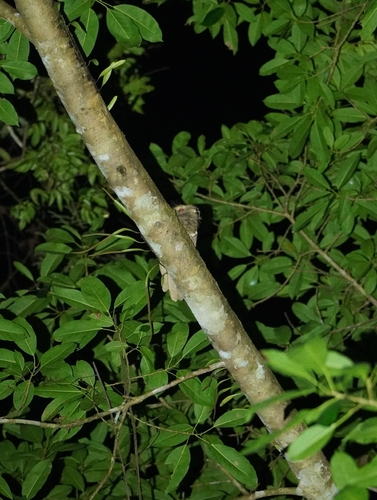 Philippine FrogmouthBatrachostomus septimusLike all frogmouths, the Philippine frogmouth has large eyes for better night vision, a large flat bill for capturing insects, and cryptic plumage which allows them to be camouflaged while perched during the day.
Learn the Sri Lanka Frogmouth in the BeakBrain App
Photo and call practice. Coming soon to iPhone and Android.
Play today's Daily BirdEvery photo and recording on this page is credited to its author under the licence shown. Spotted a problem with this page, or have a better photo? Contribute.