Learn what every symbol on the card means.Full credits and sources at beakbrain.com/symbols
 GrasslandCup nestHuge · 2.5 kg


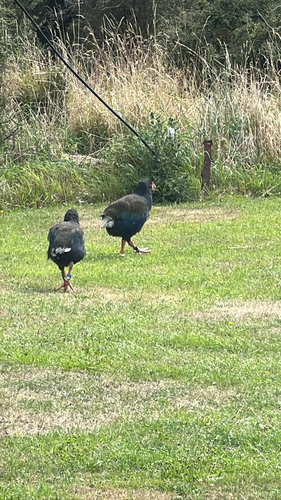


ID tip
The South Island takahē is the largest living member of the family Rallidae. Its overall length averages 63 cm (25 in) and its average weight is about 2.7 kg (6.0 lb) in males and 2.3 kg (5.1 lb) in females, ranging from 1.8–4.2 kg (4.0–9.3 lb). The lifespan of a takahē can range from 18 years in the wild or 22 in animal sanctuaries. Its standing height is around 50 cm (20 in). It is a stocky, powerful bird, with short strong legs and a massive bill which can deliver a painful bite to the unwary.
Text from Wikipedia, licensed CC BY-SA 4.0.
When to see the South Island Takahe
One bar for each month, and every month is filled: this bird is recorded here in all twelve. The wide bar is November, the month with the most records.
Where to see the South Island Takahe
The map shades 1 country with regular records. Everything unshaded has no records. Countries are listed below the map.
About the South Island Takahe
The South Island takahē is a flightless swamphen indigenous to New Zealand and the largest living member of the rail family. It is often known by the abbreviated name takahē, which it shares with the recently extinct North Island takahē. The two takahē species are also known as notornis.
Text adapted from Wikipedia, licensed CC BY-SA 4.0.
Easily confused with
 Allen's GallinulePorphyrio alleniThey are similar in size to the only slightly larger water rail.
 Azure GallinulePorphyrio flavirostrisThe azure gallinule is 23 to 26 cm (9.1 to 10 in) long.
 Purple GallinulePorphyrio martinicaThe purple gallinule is a medium-sized rail, measuring 26–37 cm (10–15 in) in length, spanning 50–61 cm (20–24 in) across the wings and weighing 141–305 g (5.0–10.8 oz).
Side by side: Purple Gallinule vs South Island Takahe · African Crake vs South Island Takahe · Allen's Gallinule vs South Island Takahe
Learn the South Island Takahe in the BeakBrain App
Photo and call practice. Coming soon to iPhone and Android.
Play today's Daily BirdEvery photo and recording on this page is credited to its author under the licence shown. Spotted a problem with this page, or have a better photo? Contribute.