Learn what every symbol on the card means.Full credits and sources at beakbrain.com/symbols
 WetlandCup nestMedium · 93 g


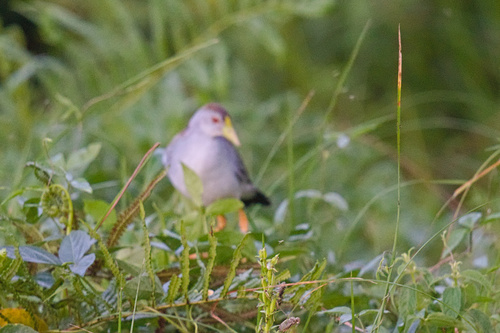
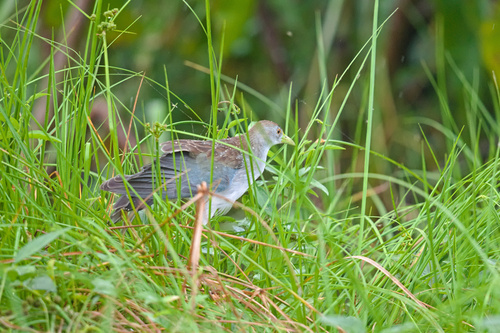
ID tip
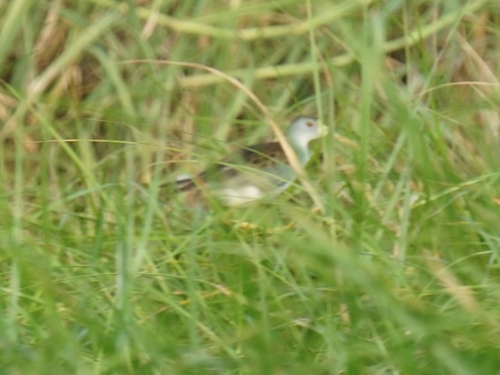
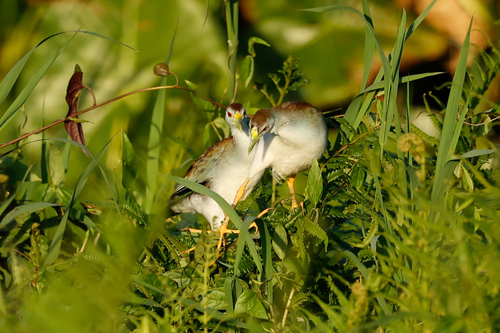
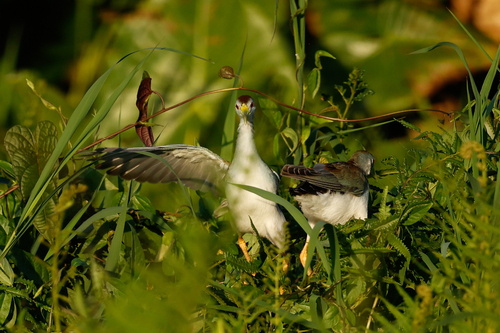
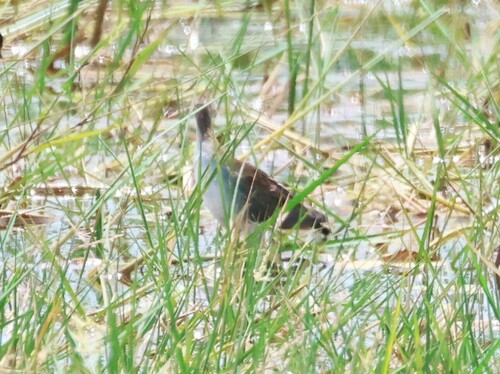
The azure gallinule is 23 to 26 cm (9.1 to 10 in) long. Males weigh 92 to 111 g (3.2 to 3.9 oz) and females 92 to 107 g (3.2 to 3.8 oz). It is the smallest member of its genus and has quite different plumage from the others. The sexes are alike. Adults have a pale greenish yellow bill and frontal shield and yellow legs and feet. They have a pale brownish olive crown, hindneck, and back. Their upperwing coverts are azure to greenish blue, their flight feathers gray-blue, and the uppertail coverts and tail brownish olive to black. Voice: The azure gallinule is usually quiet but sometimes makes "a short trill".
Text from Wikipedia, licensed CC BY-SA 4.0.
When to see the Azure Gallinule
One bar for each month. Filled bars are the 11 months with records; pale bars are months with none. The wide bar is January, the month with the most records.
Where to see the Azure Gallinule
The map shades 12 countries with regular records, and 2 more in a lighter tone where the bird turns up only as a stray. Everything unshaded has no records. Countries are listed below the map.
Recorded as a rare visitor in Uruguay, Guadeloupe.
About the Azure Gallinule
The azure gallinule is a species of bird in subfamily Rallinae of family Rallidae, the rails, gallinules, and coots. It is found in Argentina, Bolivia, Brazil, Colombia, Ecuador, French Guiana, Guyana, Paraguay, Peru, Suriname, Trinidad and Tobago, and Venezuela.
Text adapted from Wikipedia, licensed CC BY-SA 4.0.
Easily confused with
 Allen's GallinulePorphyrio alleniThey are similar in size to the only slightly larger water rail.
 South Island TakahePorphyrio hochstetteriThe South Island takahē is the largest living member of the family Rallidae.
 Purple GallinulePorphyrio martinicaThe purple gallinule is a medium-sized rail, measuring 26–37 cm (10–15 in) in length, spanning 50–61 cm (20–24 in) across the wings and weighing 141–305 g (5.0–10.8 oz).
Learn the Azure Gallinule in the BeakBrain App
Photo and call practice. Coming soon to iPhone and Android.
Play today's Daily BirdEvery photo and recording on this page is credited to its author under the licence shown. Spotted a problem with this page, or have a better photo? Contribute.