Learn what every symbol on the card means.Full credits and sources at beakbrain.com/symbols
 CoastalScrapeLarge · 526 g


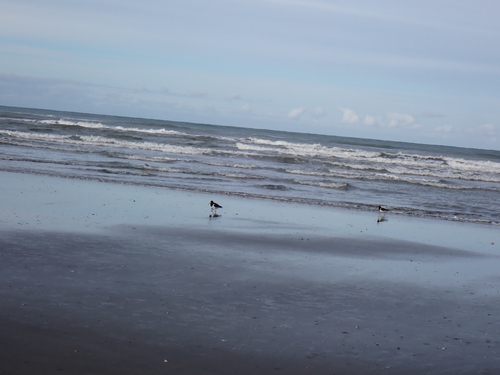
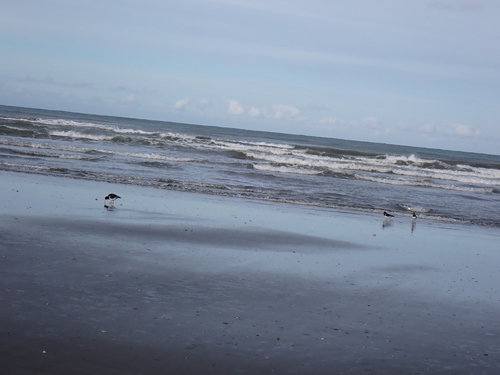


ID tip
The South Island oystercatcher is easily identifiable as a pied oystercatcher – a large wader with striking black and white plumage, long red-orange bill, and red legs. It is distinguished from the pied morph of the variable oystercatcher by a white lower back, more white on the wing, and a demarcation line of black and white further forward on the breast, and from the pied oystercatcher of Australia by a longer bill and shorter legs, as well as the forward demarcation line of white on the back being pointed rather than square. It is 46 cm in length; its wingspan is 80–86 cm; it weighs 550 g. Voice: It has piping calls, which are used socially and aggressively, as well as a piercing alarm call and a quiet flight call.
Text from Wikipedia, licensed CC BY-SA 4.0.
When to see the South Island Oystercatcher
One bar for each month, and every month is filled: this bird is recorded here in all twelve. The wide bar is November, the month with the most records.
Where to see the South Island Oystercatcher
The map shades 2 countries with regular records. Everything unshaded has no records. Countries are listed below the map.
About the South Island Oystercatcher
The South Island oystercatcher or South Island pied oystercatcher is one of two common oystercatcher species found in New Zealand. Its name is often contracted to the acronym "SIPO". The indigenous Māori name is tōrea. The scientific name commemorates the German ethnographer, naturalist and colonial explorer Friedrich Hermann Otto Finsch.
Text adapted from Wikipedia, licensed CC BY-SA 4.0.
Easily confused with
 Sooty OystercatcherHaematopus fuliginosusMeasuring 42 to 52 cm (16.5 to 20.5 in) long with a bill length of 5–8 cm (2–3 in), the sooty oystercatcher has all black plumage, with pink-red legs and scarlet or orange-red bill and eyes.
 African OystercatcherHaematopus moquiniThe African oystercatcher is a large, noisy wader, with completely black plumage, red legs and a strong broad red bill.
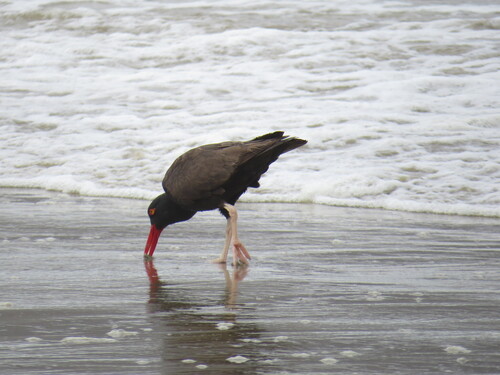 Blackish OystercatcherHaematopus aterThe blackish oystercatcher's plumage is slaty-black with wings and back rather dark brown.
Side by side: Pied Oystercatcher vs South Island Oystercatcher · South Island Oystercatcher vs Variable Oystercatcher · Sooty Oystercatcher vs South Island Oystercatcher · African Oystercatcher vs South Island Oystercatcher · Blackish Oystercatcher vs South Island Oystercatcher · Magellanic Oystercatcher vs South Island Oystercatcher
Learn the South Island Oystercatcher in the BeakBrain App
Photo and call practice. Coming soon to iPhone and Android.
Play today's Daily BirdEvery photo and recording on this page is credited to its author under the licence shown. Spotted a problem with this page, or have a better photo? Contribute.