Learn what every symbol on the card means.Full credits and sources at beakbrain.com/symbols
 CoastalScrapeLarge · 724 g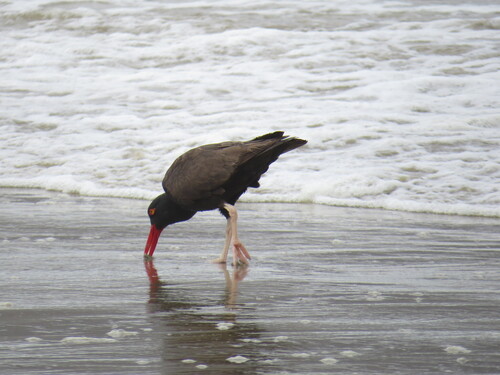
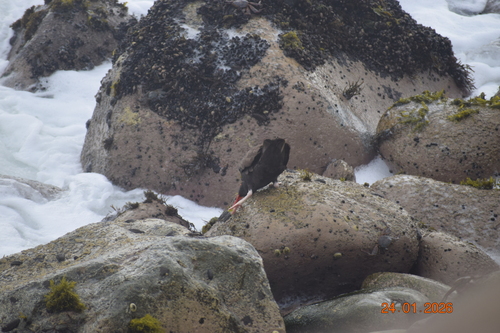

ID tip
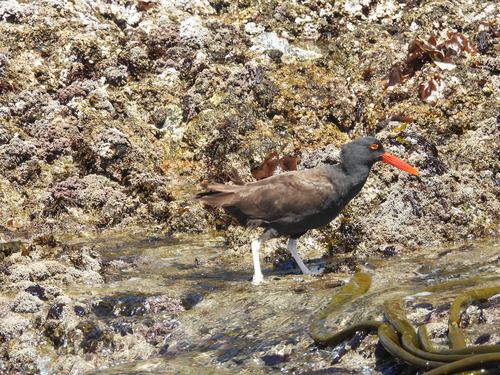
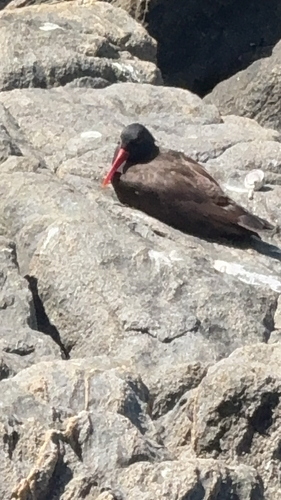
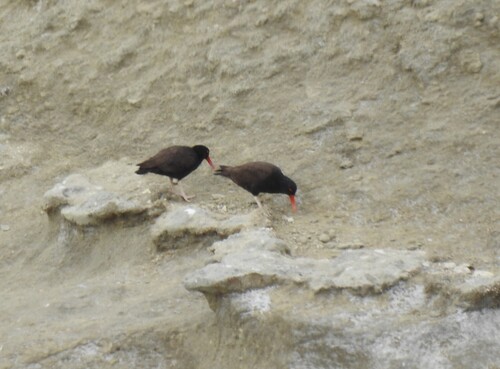
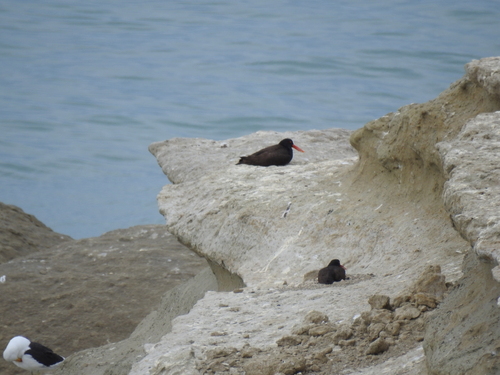
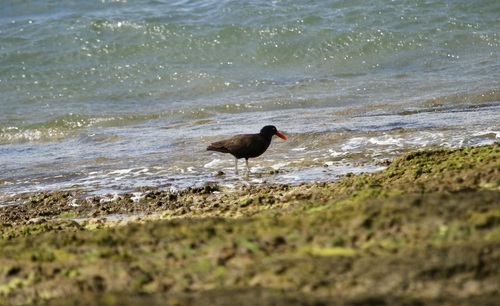
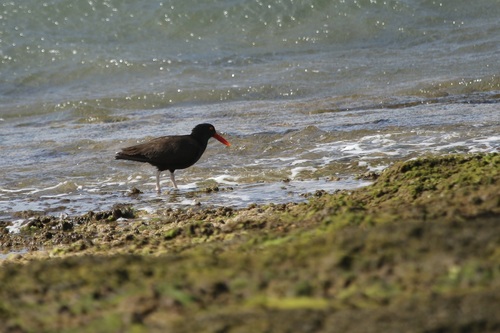
The blackish oystercatcher's plumage is slaty-black with wings and back rather dark brown. The long bill is blood-red and the legs are white. The sexes are similar in appearance. The bird is easily overlooked on a rocky shore, its dark colour blending with the rocks on which it walks as it forages, and it does not draw attention to itself. Its presence, however, can easily be detected by its loud and distinctive warning calls. Its song, when given in duet, consists of an excited chatter of piping whistles. Calls include notes that sound like "pip" and "peeeeyeeee".
Text from Wikipedia, licensed CC BY-SA 4.0.
When to see the Blackish Oystercatcher
One bar for each month, and every month is filled: this bird is recorded here in all twelve. The wide bar is November, the month with the most records.
Where to see the Blackish Oystercatcher
The map shades 6 countries with regular records, and 1 more in a lighter tone where the bird turns up only as a stray. Everything unshaded has no records. Countries are listed below the map.
Recorded as a rare visitor in United States.
About the Blackish Oystercatcher
The blackish oystercatcher is a species of wading bird in the oystercatcher family Haematopodidae. It is found in Argentina, Chile, the Falkland Islands and Peru, and is a vagrant to Uruguay. The population is estimated at 15,000–80,000.
Text adapted from Wikipedia, licensed CC BY-SA 4.0.
Easily confused with
 Magellanic OystercatcherHaematopus leucopodusThe Magellanic oystercatcher has a length between 42 and 46 cm (17 and 18 in).
 African OystercatcherHaematopus moquiniThe African oystercatcher is a large, noisy wader, with completely black plumage, red legs and a strong broad red bill.
 South Island OystercatcherHaematopus finschiThe South Island oystercatcher is easily identifiable as a pied oystercatcher – a large wader with striking black and white plumage, long red-orange bill, and red legs.
Side by side: Blackish Oystercatcher vs South Island Oystercatcher · African Oystercatcher vs Blackish Oystercatcher · Blackish Oystercatcher vs Magellanic Oystercatcher
Learn the Blackish Oystercatcher in the BeakBrain App
Photo and call practice. Coming soon to iPhone and Android.
Play today's Daily BirdEvery photo and recording on this page is credited to its author under the licence shown. Spotted a problem with this page, or have a better photo? Contribute.