Learn what every symbol on the card means.Full credits and sources at beakbrain.com/symbols
 MarineCavity nestLarge · 787 g


ID tip
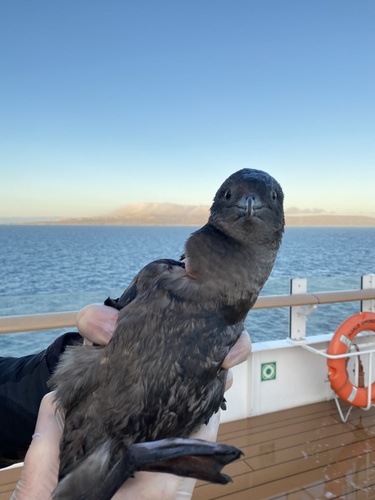
Sooty shearwaters are 40–51 cm (16–20 in) in length with a 94–110 cm (37–43 in) wingspan. It has the typical "shearing" flight of the genus, dipping from side to side on stiff wings with few wing beats, the wingtips almost touching the water. Its flight is powerful and direct, with wings held stiff and straight, giving the impression of a very small albatross. This shearwater is identifiable by its dark plumage, which is responsible for its name.
Text from Wikipedia, licensed CC BY-SA 4.0.
When to see the Sooty Shearwater
One bar for each month. Filled bars are the 8 months with records; pale bars are months with none. The wide bar is September, the month with the most records.
Where to see the Sooty Shearwater
The map shades 63 countries with regular records, and 12 more in a lighter tone where the bird turns up only as a stray. Everything unshaded has no records. Countries are listed below the map.
Recorded as a rare visitor in India, Taiwan, Kenya, Italy, Marshall Islands, Algeria, São Tomé & Príncipe, Cuba, Puerto Rico, Türkiye, Jersey, Vanuatu.
About the Sooty Shearwater
The sooty shearwater is a medium-large shearwater in the seabird family Procellariidae. In New Zealand, it is also known by its Māori name tītī, and is harvested by Māori people for muttonbird, like its relatives the wedge-tailed shearwater and the Australian short-tailed shearwater.
Text adapted from Wikipedia, licensed CC BY-SA 4.0.
Easily confused with
 Pink-footed ShearwaterArdenna creatopusMale pink-footed shearwaters on average are found to be larger than females.
 Wedge-tailed ShearwaterArdenna pacificaThe wedge-tailed shearwater is the largest of the tropical shearwaters.
 Great ShearwaterArdenna gravisThis shearwater is 43–51 cm (16.9–20.1 in) in length with a 105–122 cm (3.5–4.0 ft) wingspan.
Side by side: Pink-footed Shearwater vs Sooty Shearwater · Sooty Shearwater vs Wedge-tailed Shearwater · Great Shearwater vs Sooty Shearwater
Learn the Sooty Shearwater in the BeakBrain App
Photo and call practice. Coming soon to iPhone and Android.
Play today's Daily BirdEvery photo and recording on this page is credited to its author under the licence shown. Spotted a problem with this page, or have a better photo? Contribute.