Learn what every symbol on the card means.Full credits and sources at beakbrain.com/symbols
 MarineScrapeHuge · 1.8 kg


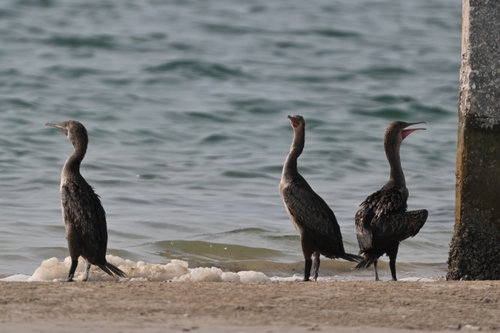
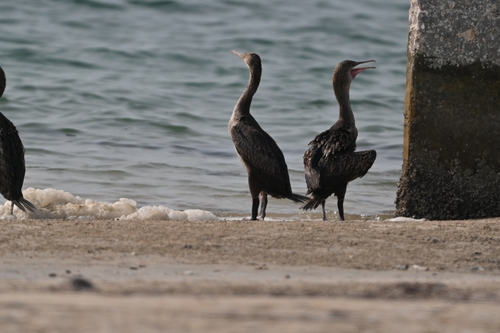
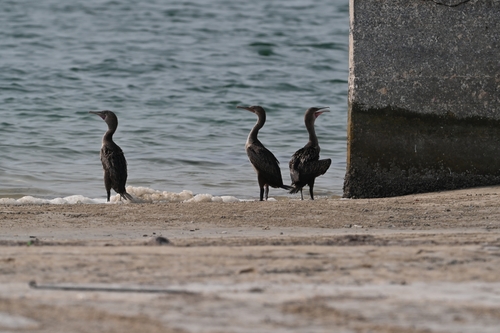
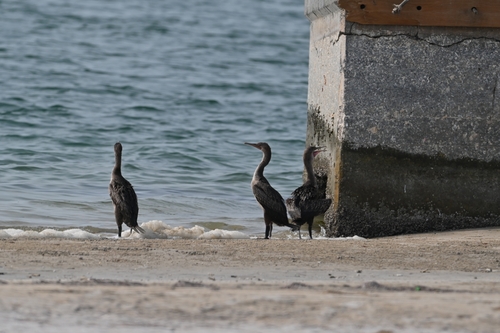
When to see the Socotra Cormorant
One bar for each month, and every month is filled: this bird is recorded here in all twelve. The wide bar is November, the month with the most records.
Where to see the Socotra Cormorant
The map shades 8 countries with regular records, and 1 more in a lighter tone where the bird turns up only as a stray. Everything unshaded has no records. Countries are listed below the map.
Recorded as a rare visitor in Djibouti.
About the Socotra Cormorant
The Socotra cormorant is a threatened species of cormorant that is endemic to the Persian Gulf and the south-east coast of the Arabian Peninsula. It is also sometimes known as the Socotran cormorant or, more rarely, as the Socotra shag. Individuals occasionally migrate as far west as the Red Sea coast. Despite its name, it was only confirmed in 2005 that it breeds on the Socotra islands in the Indian Ocean.
Text adapted from Wikipedia, licensed CC BY-SA 4.0.
Easily confused with
 Bank CormorantPhalacrocorax neglectusThe bank cormorant is a heavy-bodied bird, roughly 75 cm in length.
 Japanese CormorantPhalacrocorax capillatusThe Japanese cormorant, also known as Temminck's cormorant, is a species of cormorant native to coastal areas of the east Palearctic.
 Pitt ShagPhalacrocorax featherstoniMembers of the shag family belong to three groups, based on the color of their feet: black, yellow or pink.
Learn the Socotra Cormorant in the BeakBrain App
Photo and call practice. Coming soon to iPhone and Android.
Play today's Daily BirdEvery photo and recording on this page is credited to its author under the licence shown. Spotted a problem with this page, or have a better photo? Contribute.