Learn what every symbol on the card means.Full credits and sources at beakbrain.com/symbols
 WetlandCavity nestLarge · 609 g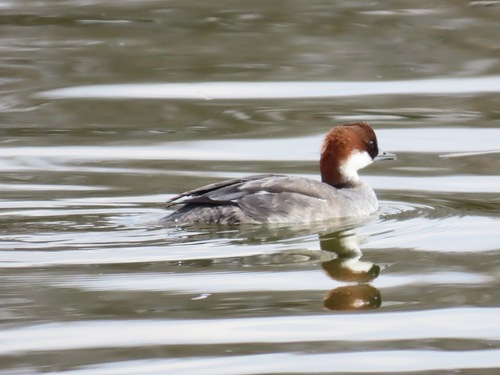


ID tip
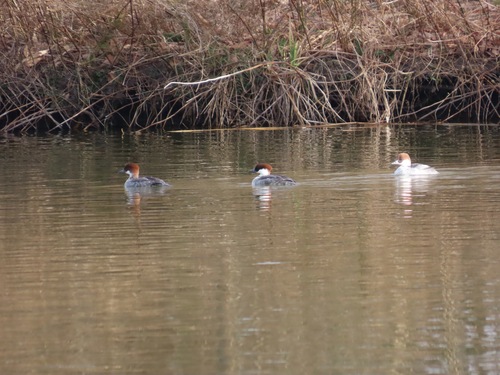
The smew is 38–44 cm (15–17 in) long, with a wingspan of 56–69 cm (22–27 in), and a weight of 450–650 g (16–23 oz). Adult drake smew, with its 'cracked ice' or 'panda' appearance, is unmistakable, and looks very black-and-white in flight. The females and immature males are grey, with chestnut forehead and crown, white chin and cheeks, and black lores; they are often known as "redhead" smew.
Text from Wikipedia, licensed CC BY-SA 4.0.
When to see the Smew
One bar for each month. Filled bars are the 8 months with records; pale bars are months with none. The wide bar is January, the month with the most records.
Where to see the Smew
The map shades 52 countries with regular records, and 4 more in a lighter tone where the bird turns up only as a stray. Everything unshaded has no records. Countries are listed below the map.
Recorded as a rare visitor in United States, Canada, Iraq, Bosnia & Herzegovina.
About the Smew
The smew is a species of duck and is the only living member of the genus Mergellus. The genus is closely related to Mergus and is sometimes included in it; genetic studies have shown that it is the sister taxon to Mergus and Lophodytes. The smew has hybridised with the common goldeneye.
Text adapted from Wikipedia, licensed CC BY-SA 4.0.
Easily confused with
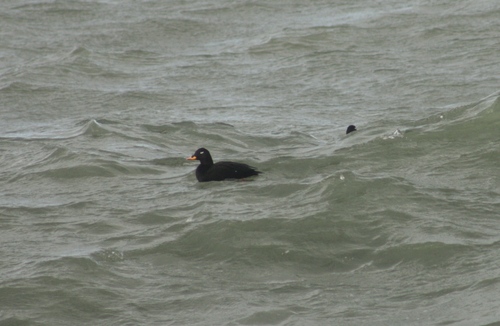 Velvet ScoterMelanitta fuscaThe velvet scoter is 51–56 cm (20–22 in) in length and has a wingspan of 90–99 cm (35–39 in).
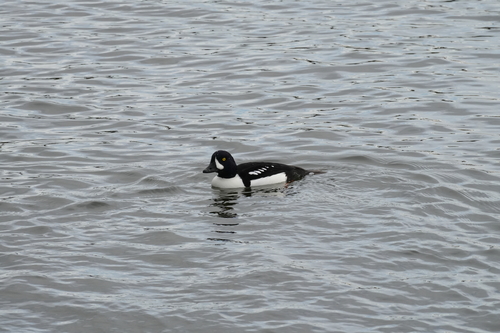 Barrow's GoldeneyeBucephala islandicaAdults are similar in appearance to the common goldeneye.
 Harlequin DuckHistrionicus histrionicusAdult breeding males have a colorful and complex plumage pattern.
Side by side: Smew vs Velvet Scoter · Barrow's Goldeneye vs Smew · Harlequin Duck vs Smew
Learn the Smew in the BeakBrain App
Photo and call practice. Coming soon to iPhone and Android.
Play today's Daily BirdEvery photo and recording on this page is credited to its author under the licence shown. Spotted a problem with this page, or have a better photo? Contribute.