Learn what every symbol on the card means.Full credits and sources at beakbrain.com/symbols
 WetlandPlatform nestLarge · 321 g






ID tip
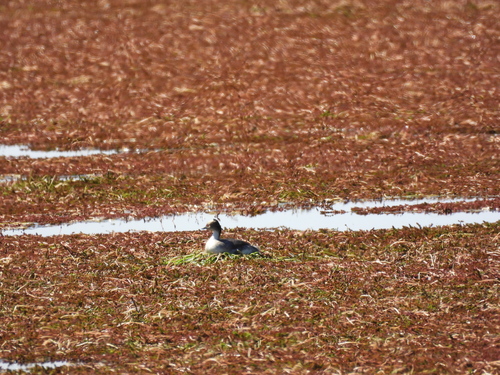
The silvery grebe is about 28 cm (11 in) in length. There are two different subspecies which differ in the colouring on their head and facial plumes. In the southern form, the ear plumes are yellowish and the side of the head and throat are grey. In the northern form, the ear plumes are grey and the side of the head and throat are white. Both have a crown that is black and the neck, chest and belly are white while the back is dark grey and the sides and flanks blackish. The beak and feet are black and the eye red.
Text from Wikipedia, licensed CC BY-SA 4.0.
When to see the Silvery Grebe
One bar for each month, and every month is filled: this bird is recorded here in all twelve. The wide bar is October, the month with the most records.
Where to see the Silvery Grebe
The map shades 9 countries with regular records, and 1 more in a lighter tone where the bird turns up only as a stray. Everything unshaded has no records. Countries are listed below the map.
Recorded as a rare visitor in Colombia.
About the Silvery Grebe
The silvery grebe is a species of grebe in the family Podicipedidae. It is found in the western and southern part of South America where it inhabits lakes and other types of open wetlands. There are two subspecies, which by some recent authorities are considered separate species.
Text adapted from Wikipedia, licensed CC BY-SA 4.0.
Easily confused with
 Hooded GrebePodiceps gallardoiThe main features of the hooded grebe's appearance which can be used for identification.
 Junin GrebePodiceps taczanowskiiWith a size of approximately 35 cm (14 in), the Junin grebe has a dark grey crown extending down the back of its neck to a black back.
 Great GrebePodiceps majorThis is a very large grebe, with proportions more like a goose or a cormorant than a typical grebe.
Side by side: Great Grebe vs Silvery Grebe
Learn the Silvery Grebe in the BeakBrain App
Photo and call practice. Coming soon to iPhone and Android.
Play today's Daily BirdEvery photo and recording on this page is credited to its author under the licence shown. Spotted a problem with this page, or have a better photo? Contribute.