Learn what every symbol on the card means.Full credits and sources at beakbrain.com/symbols
 ForestCavity nestLarge · 1.2 kg




What the Silvery-cheeked Hornbill sounds like


ID tip
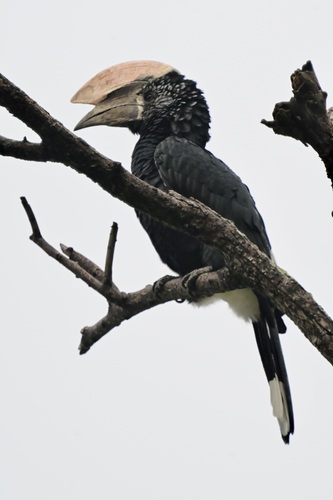
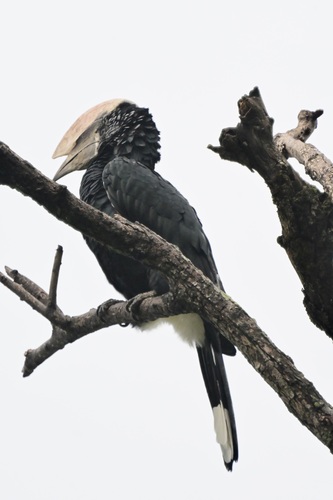
It measures 75 to 80 centimetres (30 to 31 in) in length, and has a very large cream-colored casque on the beak. The head is silver-grey and the rest of the plumage is iridescent black, except for the white rump, lower back, thighs, vent and tip of the outer tail-feathers. The sexes are similar except the female has a smaller casque and reddish skin around the eyes.
Text from Wikipedia, licensed CC BY-SA 4.0.
When to see the Silvery-cheeked Hornbill
One bar for each month, and every month is filled: this bird is recorded here in all twelve. The wide bar is November, the month with the most records.
Where to see the Silvery-cheeked Hornbill
The map shades 7 countries with regular records, and 1 more in a lighter tone where the bird turns up only as a stray. Everything unshaded has no records. Countries are listed below the map.
Recorded as a rare visitor in South Africa.
About the Silvery-cheeked Hornbill
The silvery-cheeked hornbill is a large species of hornbill found in Africa. Silvery-cheeked hornbills are residents of the tall evergreen forests of East Africa from Ethiopia to South Africa. In Zimbabwe it is threatened by habitat destruction and its presence in South Africa is marginal, but it remains locally fairly common, especially in the northern and central parts of its range.
Text adapted from Wikipedia, licensed CC BY-SA 4.0.
Easily confused with
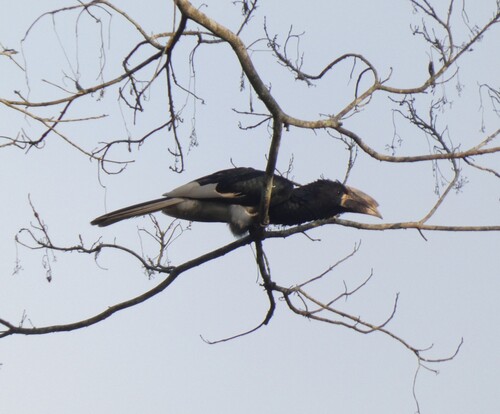 Piping HornbillBycanistes fistulatorThe piping hornbill is a bird in the hornbill family.
 Black-and-white-casqued HornbillBycanistes subcylindricusBycanistes subcylindricus is a moderately large bird of 60 to 70 cm with a wing span of 70 to 96 cm.
 White-thighed HornbillBycanistes albotibialisThe white-thighed hornbill is a species of hornbill.
Side by side: Black-and-white-casqued Hornbill vs Silvery-cheeked Hornbill
Learn the Silvery-cheeked Hornbill in the BeakBrain App
Photo and call practice. Coming soon to iPhone and Android.
Play today's Daily BirdEvery photo and recording on this page is credited to its author under the licence shown. Spotted a problem with this page, or have a better photo? Contribute.