Learn what every symbol on the card means.Full credits and sources at beakbrain.com/symbols
 ForestCavity nestLarge · 1.2 kg


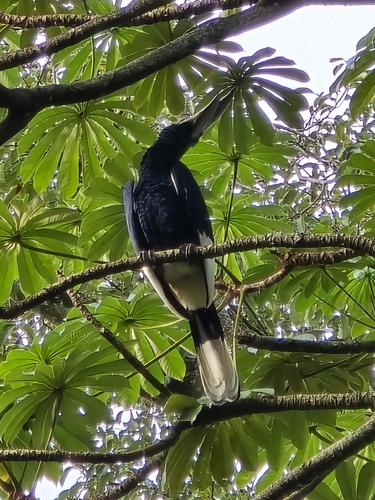
ID tip
Bycanistes subcylindricus is a moderately large bird of 60 to 70 cm with a wing span of 70 to 96 cm. It is recognizable by its black plummage for the higher body and wings alongside and white plummage on the lower body and wings with black feathers amongst the white feathers of the tail, particularly the top tail feathers and the base of the tail feathers. It has a yellow-brownish bill and flattened casque, which are enlarged in males. Females have a smaller casque and a black bill. The purpose of the casque is unknown for males, although suggested to be for sexual characterization.
Text from Wikipedia, licensed CC BY-SA 4.0.
When to see the Black-and-white-casqued Hornbill
One bar for each month. Filled bars are the 11 months with records; pale bars are months with none. The wide bar is July, the month with the most records.
Where to see the Black-and-white-casqued Hornbill
The map shades 15 countries with regular records, and 1 more in a lighter tone where the bird turns up only as a stray. Everything unshaded has no records. Countries are listed below the map.
Recorded as a rare visitor in Guinea.
About the Black-and-white-casqued Hornbill
The black-and-white-casqued hornbill, also known as the grey-cheeked hornbill, is a large black and white hornbill. It has an oversized blackish bill with a large casque on top. The female is slightly smaller than the male and has a significantly smaller casque. It is a monogamous species, and pairs nest in suitable tree cavities. The female usually lays up to two eggs. The diet consists mainly of figs, fruits, insects and small animals found in the trees.
Text adapted from Wikipedia, licensed CC BY-SA 4.0.
Easily confused with
 Silvery-cheeked HornbillBycanistes brevisIt measures 75 to 80 centimetres (30 to 31 in) in length, and has a very large cream-colored casque on the beak.
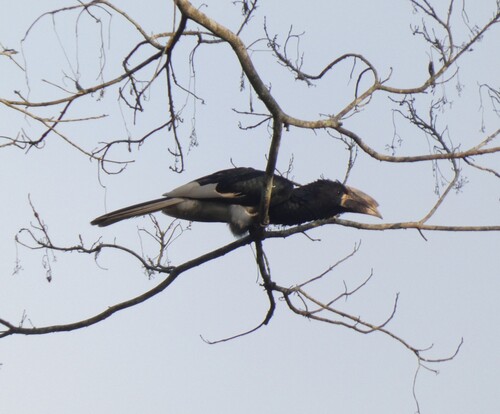 Piping HornbillBycanistes fistulatorThe piping hornbill is a bird in the hornbill family.
 White-thighed HornbillBycanistes albotibialisThe white-thighed hornbill is a species of hornbill.
Side by side: Black-and-white-casqued Hornbill vs Silvery-cheeked Hornbill
Learn the Black-and-white-casqued Hornbill in the BeakBrain App
Photo and call practice. Coming soon to iPhone and Android.
Play today's Daily BirdEvery photo and recording on this page is credited to its author under the licence shown. Spotted a problem with this page, or have a better photo? Contribute.