Learn what every symbol on the card means.Full credits and sources at beakbrain.com/symbols
 ShrublandCup nestTiny · 13 g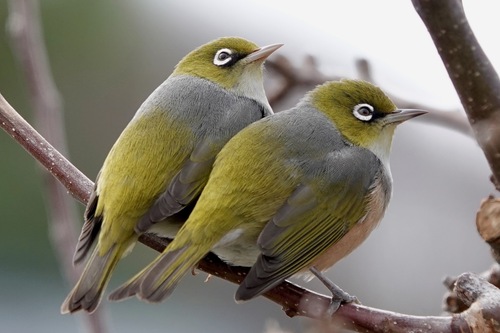


What the Silvereye sounds like

ID tip
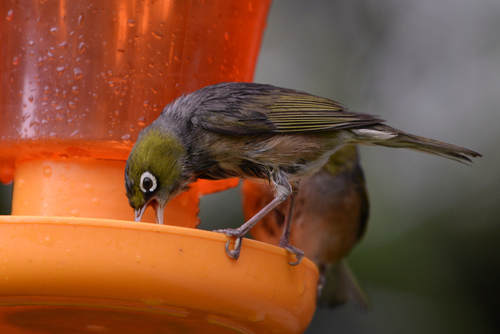
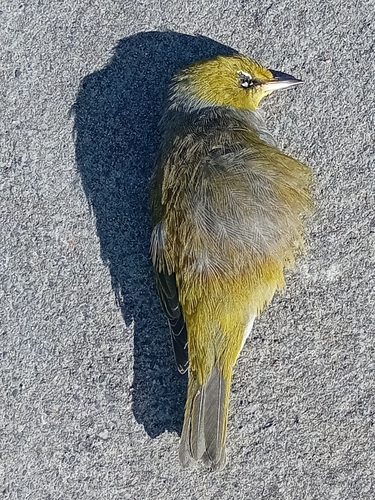
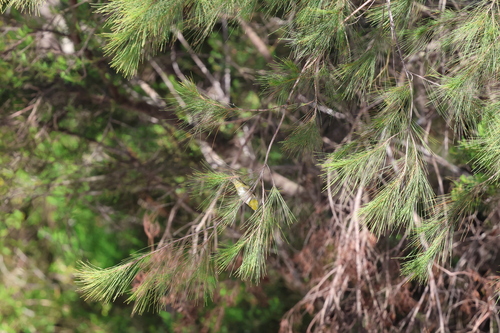
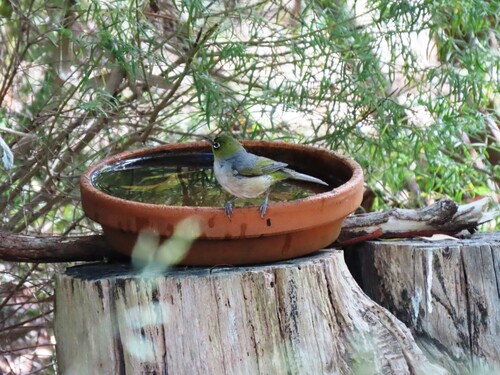
A small bird 11 to 13 cm in length and around 10 g in weight, it has a conspicuous ring of white feathers around its eye. There are a number of plumage variations depending on the sub-species. Generally it has olive-green wings and either a grey or olive-green back, a lighter coloured throat - yellow or grey, flanks that range from chestnut to pale buff, and an undertail that may be white or yellow. Within Australia there are seasonal migrations and the ranges of the sub-species overlap.
Text from Wikipedia, licensed CC BY-SA 4.0.
When to see the Silvereye
One bar for each month, and every month is filled: this bird is recorded here in all twelve. The wide bar is January, the month with the most records.
Where to see the Silvereye
The map shades 6 countries with regular records, and 1 more in a lighter tone where the bird turns up only as a stray. Everything unshaded has no records. Countries are listed below the map.
Recorded as a rare visitor in United Kingdom.
About the Silvereye
The silvereye or wax-eye, also known by its Māori name tauhou, is a very small omnivorous passerine bird of the south-west Pacific. In Australia and New Zealand its common name is sometimes white-eye, but this name is more commonly used to refer to all members of the genus Zosterops, or the entire family Zosteropidae.
Text adapted from Wikipedia, licensed CC BY-SA 4.0.
Easily confused with
 Swinhoe's White-eyeZosterops simplexSwinhoe's white-eye is a bird species in the white-eye family, Zosteropidae.
 Indian White-eyeZosterops palpebrosusThis bird is small (about 8–9 cm long) with yellowish olive upper parts, a white eye ring, a yellow throat, and a vent.
 Cape White-eyeZosterops virensThis species is about 12 cm long with rounded wings, strong legs, and a conspicuous ring of white feathers round the eyes.
Side by side: Indian White-eye vs Silvereye · Cape White-eye vs Silvereye
Learn the Silvereye in the BeakBrain App
Photo and call practice. Coming soon to iPhone and Android.
Play today's Daily BirdEvery photo and recording on this page is credited to its author under the licence shown. Spotted a problem with this page, or have a better photo? Contribute.