Learn what every symbol on the card means.Full credits and sources at beakbrain.com/symbols
 ForestScrapeLarge · 686 g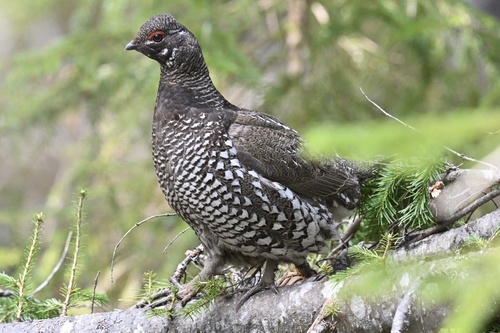
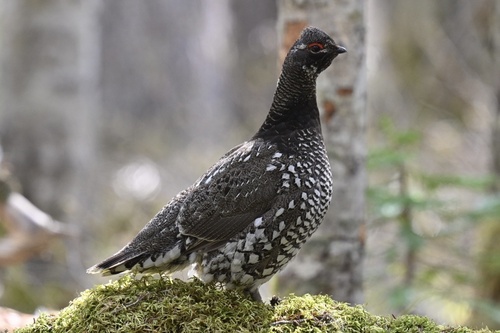


ID tip
Adults measure around 38–43 centimetres (15–17 in). Males weigh at 580–735 grams (1.279–1.620 lb), while females weigh 650–740 grams (1.43–1.63 lb). Both sexes are intricately speckled white on the belly, flanks, and undertail coverts with white streaks on the wing coverts and rump, plus a white terminal band at the tail tip. Males have sooty brownish-grey feathers with a ruff around its neck and a black bib outlined in white with red skin above each eye. Females are more pale brown in color and lack the distinct facial markings of the male.
Text from Wikipedia, licensed CC BY-SA 4.0.
When to see the Siberian Grouse
One bar for each month. Filled bars are the 4 months with records; pale bars are months with none. The wide bar is June, the month with the most records.
Where to see the Siberian Grouse
The map shades 1 country with regular records. Everything unshaded has no records. Countries are listed below the map.
About the Siberian Grouse
The Siberian grouse, also known as Siberian spruce grouse, Amur grouse, or Asian spruce grouse, is a short, rotund forest-dwelling grouse. A sedentary, non-migratory bird, it is the only member of the genus Falcipennis. The spruce grouse of North America, which physically looks similar, is now placed in the monotypic genus Canachites.
Text adapted from Wikipedia, licensed CC BY-SA 4.0.
Easily confused with
 Udzungwa Forest PartridgeXenoperdix udzungwensisVoice: The advertisement call is a short series of loud notes that can be heard up to 100 m away.
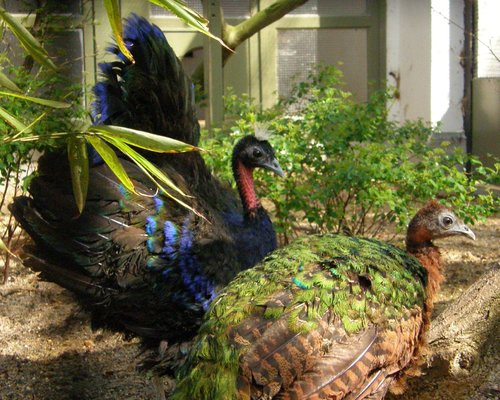 Congo PeafowlAfropavo congensisThe male (peacock) of this species is a large bird of up to 64–70 cm (25–28 in) in length.
Learn the Siberian Grouse in the BeakBrain App
Photo and call practice. Coming soon to iPhone and Android.
Play today's Daily BirdEvery photo and recording on this page is credited to its author under the licence shown. Spotted a problem with this page, or have a better photo? Contribute.