Learn what every symbol on the card means.Full credits and sources at beakbrain.com/symbols
 ForestScrapeLarge · 1.3 kg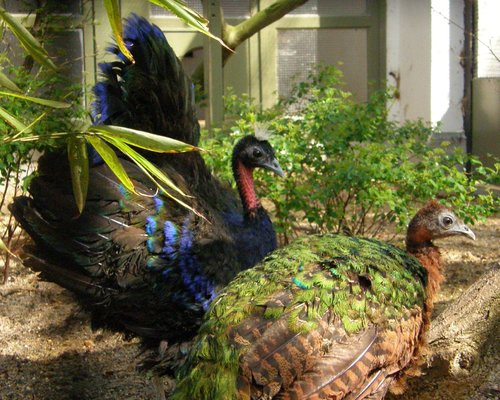


ID tip
The male (peacock) of this species is a large bird of up to 64–70 cm (25–28 in) in length. Though much less impressive than his Asiatic cousins, the male's feathers are nevertheless deep blue with a metallic green and violet tinge. He has bare red neck skin, grey feet, and a black tail with fourteen tail feathers. His crown is adorned with vertical white elongated hair-like feathers. The female (peahen) measures up to 60–63 centimetres (24–25 in) in length; generally, she is a chestnut brown bird with a black abdomen, metallic green back, and a short chestnut brown crest.
Text from Wikipedia, licensed CC BY-SA 4.0.
When to see the Congo Peafowl
One bar for each month. Filled bars are the 10 months with records; pale bars are months with none. The wide bar is December, the month with the most records.
Where to see the Congo Peafowl
The map shades 1 country with regular records. Everything unshaded has no records. Countries are listed below the map.
About the Congo Peafowl
The Congo peafowl, also known as the African peafowl or mbulu by the Bakôngo, is a species native to the Congo Basin. It is one of three species commonly termed "peafowl" in the tribe Pavonini native to Africa. It represents the sole extant member of the genus Afropavo. It is listed as Near Threatened on the IUCN Red List.
Text adapted from Wikipedia, licensed CC BY-SA 4.0.
Easily confused with
 Udzungwa Forest PartridgeXenoperdix udzungwensisVoice: The advertisement call is a short series of loud notes that can be heard up to 100 m away.
 Black PartridgeMelanoperdix nigerThe black partridge, also known as the black wood partridge, is a small partridge with a thick bill, grey legs and dark brown iris.
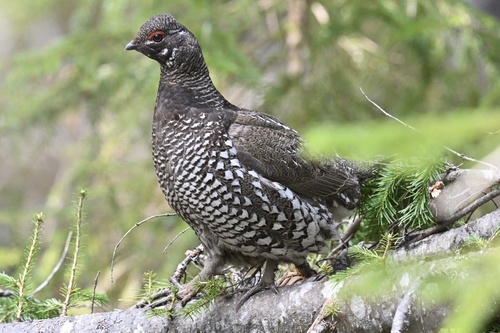 Siberian GrouseFalcipennis falcipennisAdults measure around 38–43 centimetres (15–17 in).
Learn the Congo Peafowl in the BeakBrain App
Photo and call practice. Coming soon to iPhone and Android.
Play today's Daily BirdEvery photo and recording on this page is credited to its author under the licence shown. Spotted a problem with this page, or have a better photo? Contribute.