Learn what every symbol on the card means.Full credits and sources at beakbrain.com/symbols
 ForestDomed nestTiny · 12 g


What the Sepia-capped Flycatcher sounds like

ID tip
The sepia-capped flycatcher is 11.5 to 14 cm (4.5 to 5.5 in) long and weighs an average of about 12 g (0.42 oz). The sexes have the same plumage. Adults of the nominate subspecies L. a. amaurocephalus have a sepia brown crown and a paler nape. Their lores are dull yellowish olive with some dusky mixed in and their ear coverts have a dusky patch at the rear. Their face is otherwise light olive. Their back and rump are olive green and their uppertail coverts russet brown. Their wings are dusky with pale yellowish olive edges on the flight feathers. Voice: Various authors have described the sepia-capped flycatcher's song as "a harsh, almost explosive SKET'a'a'j'j'j or SKET'd'd'r'r'r', last part chattery and vibrating" , "a fast, sputtering chatter that trails off toward end, e.g., dre- d'd'd'd'd'd'd'dew, sometimes introduced by a sharper, more emphasized note", and "an abrupt, loud, slightly falling, semimusical chatter: ski'i'i'i'i'i'i'i'eew".
Text from Wikipedia, licensed CC BY-SA 4.0.
When to see the Sepia-capped Flycatcher
One bar for each month, and every month is filled: this bird is recorded here in all twelve. The wide bar is October, the month with the most records.
Where to see the Sepia-capped Flycatcher
The map shades 17 countries with regular records, and 1 more in a lighter tone where the bird turns up only as a stray. Everything unshaded has no records. Countries are listed below the map.
Recorded as a rare visitor in Uruguay.
About the Sepia-capped Flycatcher
The sepia-capped flycatcher is a species of bird in the family Tyrannidae, the tyrant flycatchers. It is found in Mexico, every Central American country except El Salvador, and every mainland South American country except Chile; it is known in Uruguay as a vagrant.
Text adapted from Wikipedia, licensed CC BY-SA 4.0.
Easily confused with
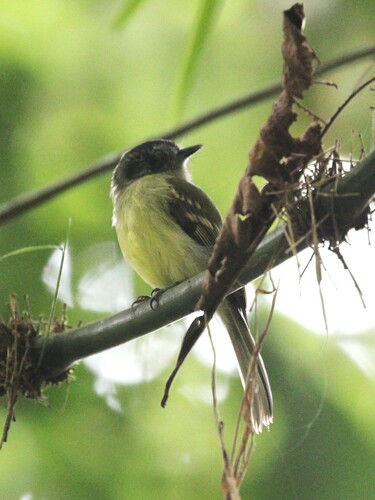 Slaty-capped FlycatcherLeptopogon superciliarisThe slaty-capped flycatcher is 13 to 14 cm (5.1 to 5.5 in) long and weighs 9.5 to 14.8 g (0.34 to 0.52 oz).
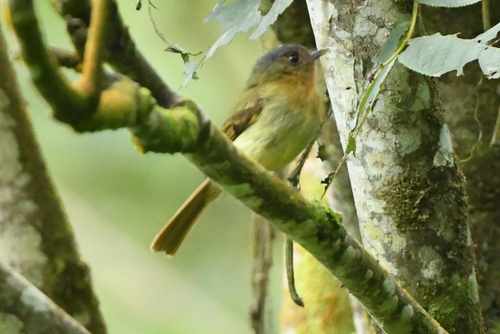 Rufous-breasted FlycatcherLeptopogon rufipectusThe rufous-breasted flycatcher is 13 to 13.5 cm (5.1 to 5.3 in) long; six individuals weighed 10 to 18 g (0.35 to 0.63 oz).
 Inca FlycatcherLeptopogon taczanowskiiThe Inca flycatcher is 12 to 13.5 cm (4.7 to 5.3 in) long; two individuals weighed 11.5 g (0.41 oz) and a third 13 g (0.46 oz).
Side by side: Sepia-capped Flycatcher vs Slaty-capped Flycatcher · Lesser Kiskadee vs Sepia-capped Flycatcher · Rufous-breasted Flycatcher vs Sepia-capped Flycatcher
Learn the Sepia-capped Flycatcher in the BeakBrain App
Photo and call practice. Coming soon to iPhone and Android.
Play today's Daily BirdEvery photo and recording on this page is credited to its author under the licence shown. Spotted a problem with this page, or have a better photo? Contribute.