
Sepia-capped Flycatcher
Leptopogon amaurocephalus
The sepia-capped flycatcher is 11.5 to 14 cm (4.5 to 5.5 in) long and weighs an average of about 12 g (0.42 oz). The sexes have the same plumage. Adults of the nominate subspecies L. a. amaurocephalus have a sepia brown crown and a paler nape. Their lores are dull yellowish olive with some dusky mixed in and their ear coverts have a dusky patch at the rear. Their face is otherwise light olive. Their back and rump are olive green and their uppertail coverts russet brown. Their wings are dusky with pale yellowish olive edges on the flight feathers. Voice: Various authors have described the sepia-capped flycatcher's song as "a harsh, almost explosive SKET'a'a'j'j'j or SKET'd'd'r'r'r', last part chattery and vibrating" , "a fast, sputtering chatter that trails off toward end, e.g., dre- d'd'd'd'd'd'd'dew, sometimes introduced by a sharper, more emphasized note", and "an abrupt, loud, slightly falling, semimusical chatter: ski'i'i'i'i'i'i'i'eew".
ID text from Wikipedia, CC BY-SA 4.0

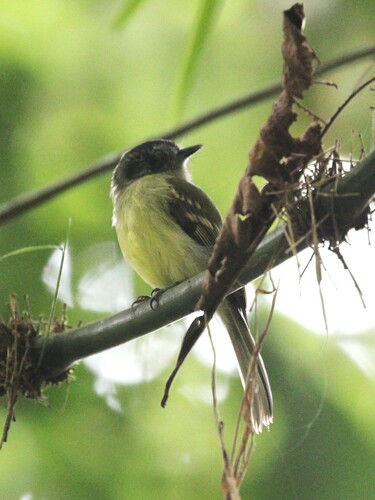
Slaty-capped Flycatcher
Leptopogon superciliaris
The slaty-capped flycatcher is 13 to 14 cm (5.1 to 5.5 in) long and weighs 9.5 to 14.8 g (0.34 to 0.52 oz). The sexes have the same plumage. Both subspecies show much plumage variation within them. Adults of the nominate subspecies have a slaty gray crown. They have white lores, a thin white supercilium, and a wide dusky to black crescent around the back of the otherwise mottled whitish face. Their back and rump are dark olive. Their wings are dusky with yellow-green edges on the flight feathers. Voice: The slaty-capped flycatcher's vocalizations apparently fall into three groups. Putative subspecies L. s. transandinus has a dawn song written as "pik..teerrrueet or pik...teerrrr". It also makes a "nagging-sounding two-part call, beginning with a sharply overslurred note and ending with a rapid trill Pik-trrrr" and a "short emphatic pit". L. s.
ID text from Wikipedia, CC BY-SA 4.0

Where you might meet both
Learn this pair in the BeakBrain App
Photo and call practice. Coming soon to iPhone and Android.
Play today's Daily BirdPhotos and recordings are credited to their authors under the licence shown. Full profiles: Sepia-capped Flycatcher and Slaty-capped Flycatcher.