Learn what every symbol on the card means.Full credits and sources at beakbrain.com/symbols
 ForestSmall · 28 g
ID tip
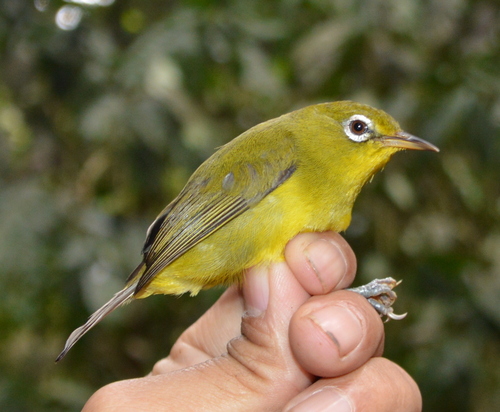
The Sanford's white-eye's average size is 15-16cm. It also has a narrow white eyering, making the eyes pop, and brown tails. Both males and females look the same. Its brown-feathered body has an olive wash on the throat. It has straw light yellow legs. It is primarily recognized for its distinctive white rings around its eyes, which is a common feature in the white-eye family. The white-eye family is also known for being very social. It typically has olive-green plumage with yellowish tones on its underparts.
Text from Wikipedia, licensed CC BY-SA 4.0.
When to see the Sanford's White-eye
One bar for each month. Filled bars are the 6 months with records; pale bars are months with none. The wide bar is March, the month with the most records.
Where to see the Sanford's White-eye
The map shades 1 country with regular records. Everything unshaded has no records. Countries are listed below the map.
About the Sanford's White-eye
Sanford's white-eye is a species of bird in the family Zosteropidae. It is endemic to Nendo Island. It is named after Leonard Cutler Sanford, a trustee of the American Museum of Natural History.
Text adapted from Wikipedia, licensed CC BY-SA 4.0.
Easily confused with
 Meratus White-eyeZosterops meratusensisThe Meratus white-eye is a typical Zosterops white-eye with deep olive-green upperparts, more yellow underparts, a yellow stripe across the lores, and a distinctive bicoloured bill.
Learn the Sanford's White-eye in the BeakBrain App
Photo and call practice. Coming soon to iPhone and Android.
Play today's Daily BirdEvery photo and recording on this page is credited to its author under the licence shown. Spotted a problem with this page, or have a better photo? Contribute.