Learn what every symbol on the card means.Full credits and sources at beakbrain.com/symbols
 ForestTiny · 9 g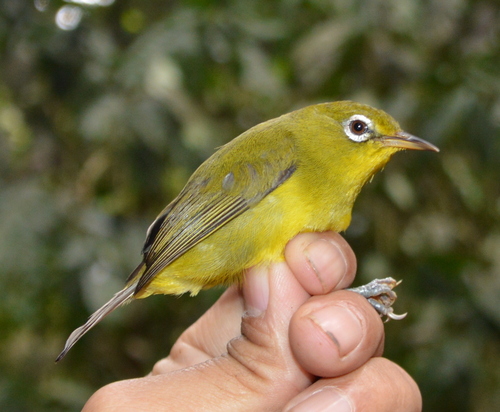

ID tip
The Meratus white-eye is a typical Zosterops white-eye with deep olive-green upperparts, more yellow underparts, a yellow stripe across the lores, and a distinctive bicoloured bill. Adults have a length of around 11–12 cm (4.3–4.7 in) and a mass of 8.5–9.5 g (0.30–0.34 oz). The wing length is 48.7–50.8 mm (1.92–2.00 in), the length of the bill is 35 mm (1.4 in), and the tail length is 12.5–13.7 mm (0.49–0.54 in). The species shows no sexual dimorphism; males and females both look alike. Voice: The song of the Meratus white-eye is one to three second long "warbling series of high-pitched short notes, ending with a faster, lower-pitched jumble". The white-eye's usual call is a high, "buzzy" zip. Spectrograms of the songs of Meratus and lemon-bellied white-eyes show the Meratus white-eye's calls being consistently higher-pitched and having shorter "phrases".
Text from Wikipedia, licensed CC BY-SA 4.0.
When to see the Meratus White-eye
One bar for each month. Filled bars are the 6 months with records; pale bars are months with none. The wide bar is September, the month with the most records.
Where to see the Meratus White-eye
The map shades 1 country with regular records. Everything unshaded has no records. Countries are listed below the map.
About the Meratus White-eye
The Meratus white-eye is a species of bird in the white-eye family, Zosteropidae. The species was described in 2021 by the Indonesian ornithologist Mohammed Irham and his colleagues based on genetic, morphological, and vocal differences from other Zosterops white-eyes. It is endemic to the Meratus Mountains of Indonesian Borneo, where it has been observed on Mount Besar and Mount Karokangen. It inhabits the mid and lower storeys of closed-canopy montane forests at elevations between 1,300 and 1,650 m. It is a typical Zosterops white-eye, with deep olive-green upperparts, yellower underparts, a yellow stripe across the lores, and a distinctive bicoloured bill.
Text adapted from Wikipedia, licensed CC BY-SA 4.0.
Easily confused with
Learn the Meratus White-eye in the BeakBrain App
Photo and call practice. Coming soon to iPhone and Android.
Play today's Daily BirdEvery photo and recording on this page is credited to its author under the licence shown. Spotted a problem with this page, or have a better photo? Contribute.