Learn what every symbol on the card means.Full credits and sources at beakbrain.com/symbols
 DesertCavity nestMedium · 190 g

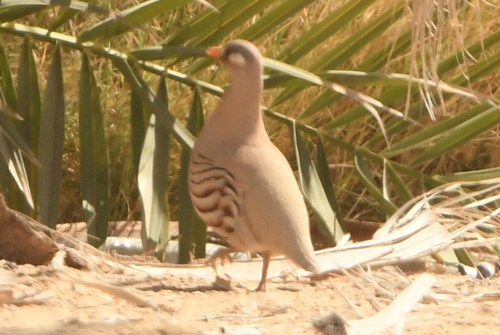
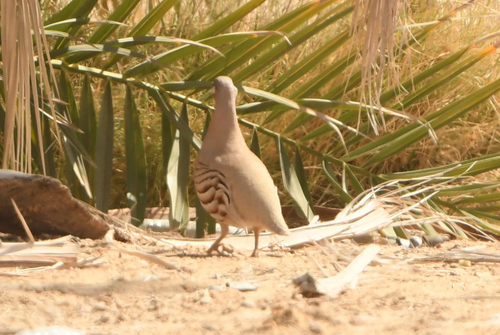
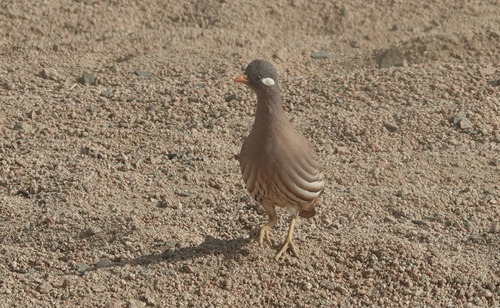
ID tip
Source: The sand partridge is a rotund bird, mainly sandy-brown with wavy white and brown flank stripes. It ranges from 22–25 cm in height, and 180-200 g in weight. Its wingspan ranges from 39–41 cm. They can live for up to 4 years. When disturbed, sand partridge prefers to run rather than fly, but if necessary it flies a short distance on rounded wings. The song is a slurred kwa-kwa-kwa Voice: Known vocalizations only for male sand partridges. Male's signalling call is a "kew-kew-kew" or "watcha-watcha-watcha". When alarmed or flushed, they emit a louder, higher "quip" or "qu-ip", or a harsh "wuit-wuit-wuit".
Text from Wikipedia, licensed CC BY-SA 4.0.
When to see the Sand Partridge
One bar for each month, and every month is filled: this bird is recorded here in all twelve. The wide bar is March, the month with the most records.
Where to see the Sand Partridge
The map shades 10 countries with regular records. Everything unshaded has no records. Countries are listed below the map.
About the Sand Partridge
The sand partridge is a gamebird in the pheasant family Phasianidae of the order Galliformes, gallinaceous birds.
Text adapted from Wikipedia, licensed CC BY-SA 4.0.
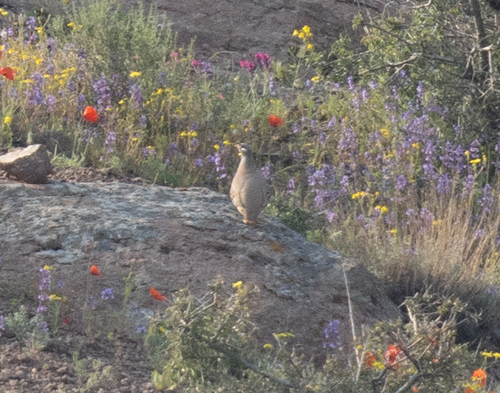
Easily confused with
Learn the Sand Partridge in the BeakBrain App
Photo and call practice. Coming soon to iPhone and Android.
Play today's Daily BirdEvery photo and recording on this page is credited to its author under the licence shown. Spotted a problem with this page, or have a better photo? Contribute.