Learn what every symbol on the card means.Full credits and sources at beakbrain.com/symbols
 RiverineCavity nestTiny · 13 g


What the Sand Martin sounds like


ID tip
The sand martin is brown above, white below with a narrow brown band on the breast; the bill is black, the legs brown. The young have rufous tips to the coverts and margins to the secondaries. Its brown back and breast band, white throat, small size and quick jerky flight separate it from similar swallows, such as the common house martin (Delichon urbicum), the American cliff swallow (Petrochelidon pyrrhonota) and the tree swallow (Tachycineta bicolor).
Text from Wikipedia, licensed CC BY-SA 4.0.
When to see the Sand Martin
One bar for each month. Filled bars are the 6 months with records; pale bars are months with none. The wide bar is May, the month with the most records.
Where to see the Sand Martin
The map shades 188 countries with regular records, and 8 more in a lighter tone where the bird turns up only as a stray. Everything unshaded has no records. Countries are listed below the map.
Recorded as a rare visitor in Vatican City, Guinea, Lesotho, Montserrat, St. Barthélemy, Turks & Caicos Islands, Liechtenstein, Palau.
About the Sand Martin
The sand martin, also known as the collared sand martin or common sand martin, and in the Americas as the bank swallow, is a migratory passerine bird in the swallow family Hirundinidae. It has a wide range in summer, embracing practically the whole Holarctic area, from Europe, across Asia to the Pacific Ocean, and throughout North America. It winters in eastern and southern Africa, southern Asia, and South America.
Text adapted from Wikipedia, licensed CC BY-SA 4.0.
Easily confused with
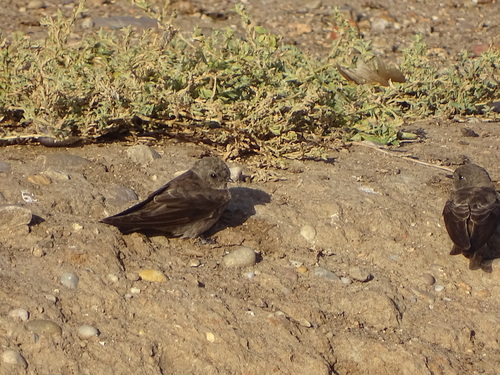 Brown-throated MartinRiparia paludicolaThe 12 cm long brown-throated martin is brown above and white or pale brown below.
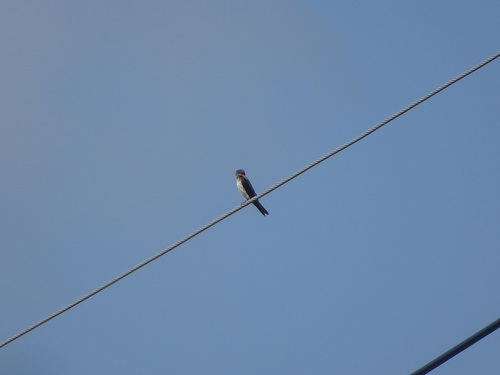 Grey-throated MartinRiparia chinensisThe grey-throated martin or Asian plain martin is a small passerine bird in the swallow family.
 Pale MartinRiparia dilutaThe pale martin or pale sand martin is a small passerine bird in the swallow family.
Side by side: Brown-throated Martin vs Sand Martin
Learn the Sand Martin in the BeakBrain App
Photo and call practice. Coming soon to iPhone and Android.
Play today's Daily BirdEvery photo and recording on this page is credited to its author under the licence shown. Spotted a problem with this page, or have a better photo? Contribute.