Learn what every symbol on the card means.Full credits and sources at beakbrain.com/symbols
 GrasslandSmall · 18 g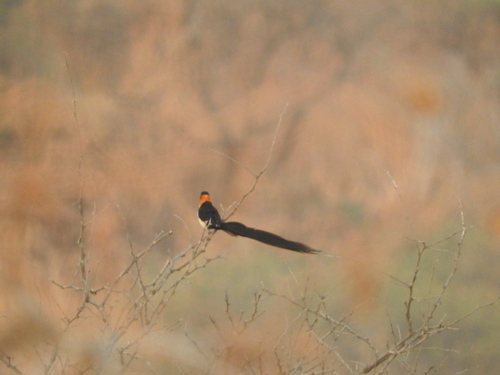
ID tip
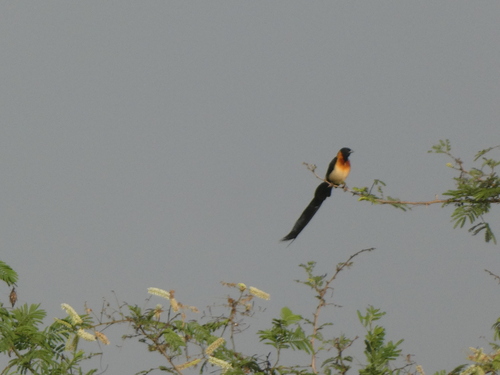
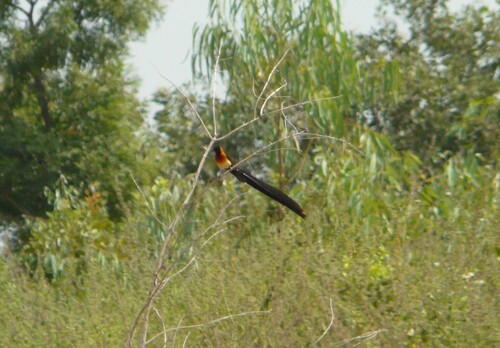
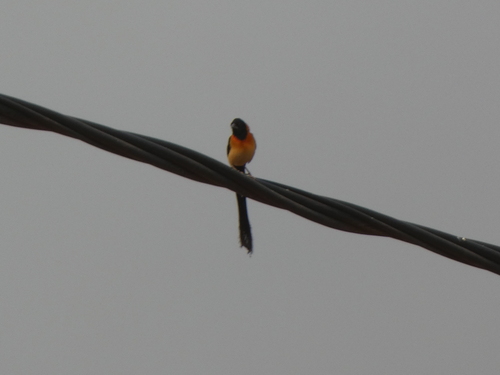
The females are 13–14 cm (5.1–5.5 in) long, tawny above with narrow mantle streaking; in females a dark line extends behind the eye. When in non-breeding plumage, the males are similar to the females; juveniles are also similar to adult females. The males in breeding plumage have black back and wings, with a rufous breast and pale belly; the head is black, with a pale nape; this is straw-yellow in the nominate eastern subspecies V. o. orientalis, and chestnut-toned like the breast in the western subspecies V. o. aucupum. The feet and the bill are dark grey.
Text from Wikipedia, licensed CC BY-SA 4.0.
When to see the Sahel Paradise Whydah
One bar for each month. Filled bars are the 8 months with records; pale bars are months with none. The wide bar is December, the month with the most records.
Where to see the Sahel Paradise Whydah
The map shades 11 countries with regular records, and 3 more in a lighter tone where the bird turns up only as a stray. Everything unshaded has no records. Countries are listed below the map.
Recorded as a rare visitor in South Sudan, Mauritania, Sudan.
About the Sahel Paradise Whydah
The Sahel paradise whydah, or northern paradise whydah is a small songbird in the passerine family Viduidae.
Text adapted from Wikipedia, licensed CC BY-SA 4.0.
Easily confused with
 Exclamatory Paradise WhydahVidua interjectaThe exclamatory paradise whydah or Uelle paradise whydah is a species of bird in the family Viduidae.
 Broad-tailed Paradise WhydahVidua obtusaThe breeding male is 31–36 cm (12–14 in) long, and the nonbreeding male and the female are 14–15 cm (5.5–5.9 in) long.
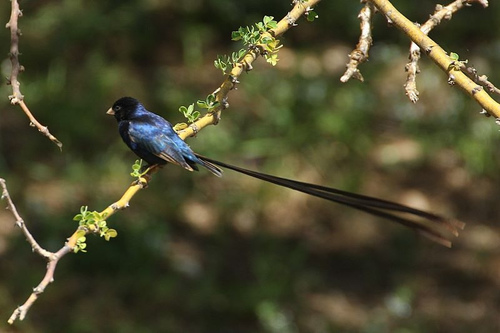 Steel-blue WhydahVidua hypocherinaThe steel-blue whydah is a species of bird in the family Viduidae.
Learn the Sahel Paradise Whydah in the BeakBrain App
Photo and call practice. Coming soon to iPhone and Android.
Play today's Daily BirdEvery photo and recording on this page is credited to its author under the licence shown. Spotted a problem with this page, or have a better photo? Contribute.