Learn what every symbol on the card means.Full credits and sources at beakbrain.com/symbols
 WoodlandSmall · 21 g
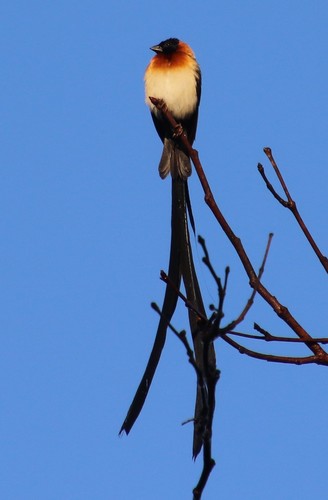


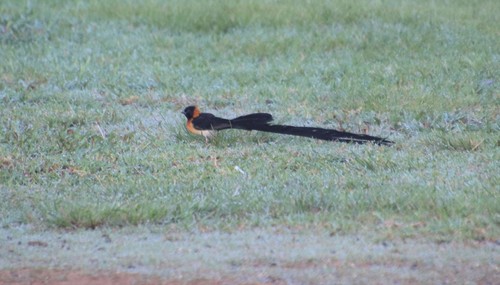
ID tip
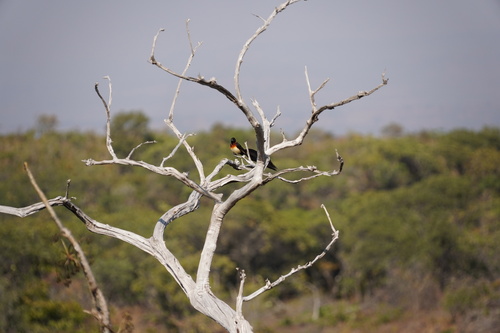
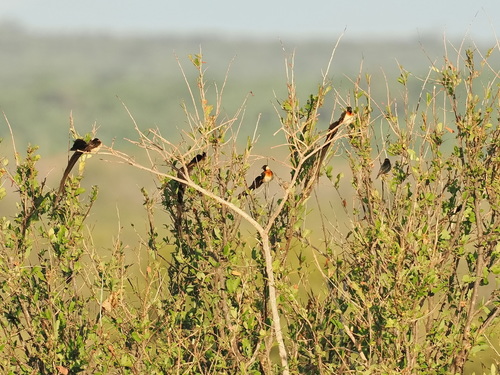
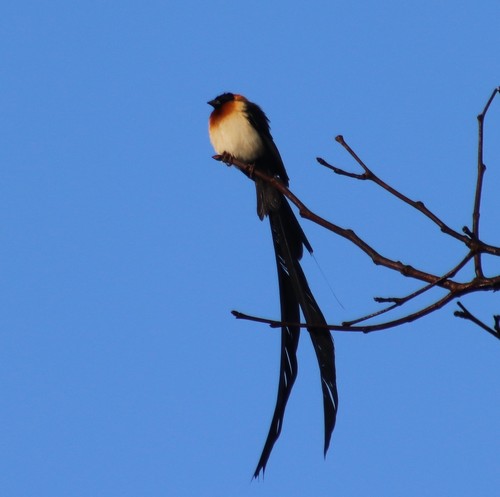
The breeding male is 31–36 cm (12–14 in) long, and the nonbreeding male and the female are 14–15 cm (5.5–5.9 in) long. Females have been measured to weigh approximately 19.5 g (0.69 oz). The breeding male has long, broad tail feathers with bluntly pointed to rounded tips; it is distinguished from the related long-tailed paradise whydah in the tail feathers being broader and not quite so long, and in the nape being orange-brown toned rather than paler buff. It has a chestnut-orange patch on its nape. The nonbreeding male's underparts are buffy, and its upperparts are grey-brown, with streaks.
Text from Wikipedia, licensed CC BY-SA 4.0.
When to see the Broad-tailed Paradise Whydah
One bar for each month. Filled bars are the 10 months with records; pale bars are months with none. The wide bar is March, the month with the most records.
Where to see the Broad-tailed Paradise Whydah
The map shades 11 countries with regular records, and 2 more in a lighter tone where the bird turns up only as a stray. Everything unshaded has no records. Countries are listed below the map.
Recorded as a rare visitor in United States, Rwanda.
About the Broad-tailed Paradise Whydah
The broad-tailed paradise whydah is a species of bird in the family Viduidae. It is found in woodland and acacia savanna habitat in Sub-Saharan Africa from Angola to Uganda, Tanzania and Mozambique. A brood parasite, it has a wide range and the International Union for Conservation of Nature has assessed it as being of least concern.
Text adapted from Wikipedia, licensed CC BY-SA 4.0.
Easily confused with
 Exclamatory Paradise WhydahVidua interjectaThe exclamatory paradise whydah or Uelle paradise whydah is a species of bird in the family Viduidae.
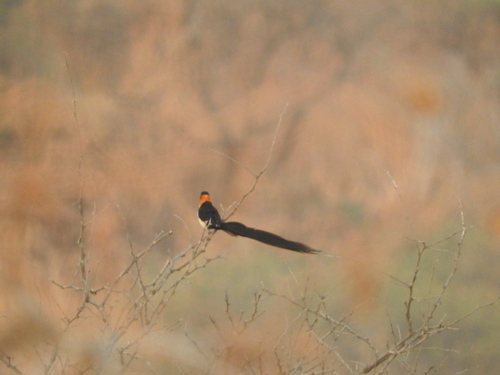 Sahel Paradise WhydahVidua orientalisThe females are 13–14 cm (5.1–5.5 in) long, tawny above with narrow mantle streaking; in females a dark line extends behind the eye.
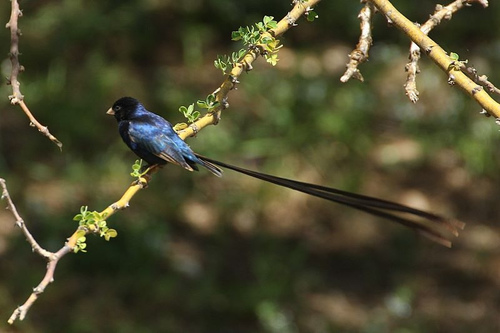 Steel-blue WhydahVidua hypocherinaThe steel-blue whydah is a species of bird in the family Viduidae.
Learn the Broad-tailed Paradise Whydah in the BeakBrain App
Photo and call practice. Coming soon to iPhone and Android.
Play today's Daily BirdEvery photo and recording on this page is credited to its author under the licence shown. Spotted a problem with this page, or have a better photo? Contribute.