Learn what every symbol on the card means.Full credits and sources at beakbrain.com/symbols
 ShrublandCup nestSmall · 44 g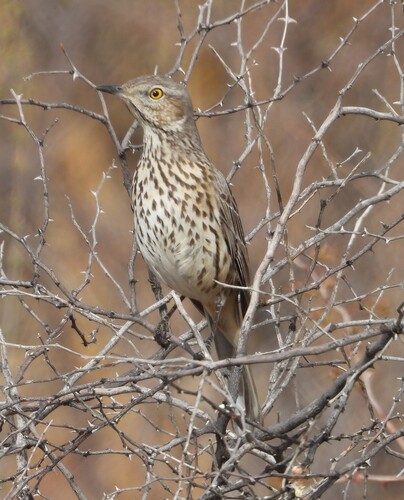


ID tip
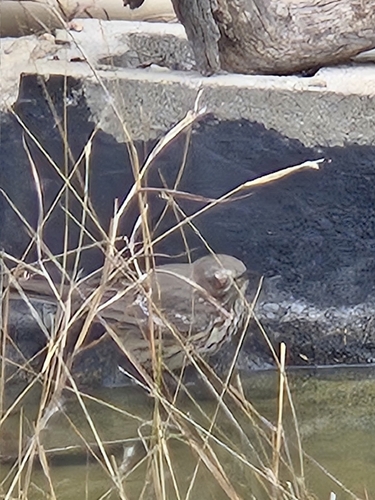
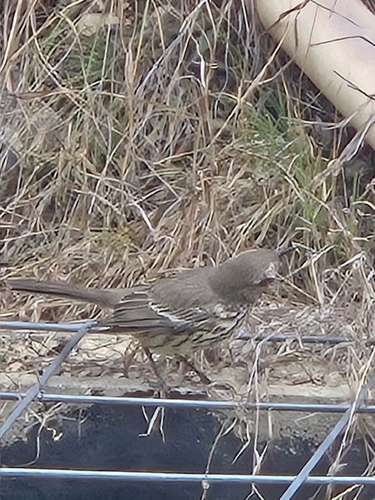
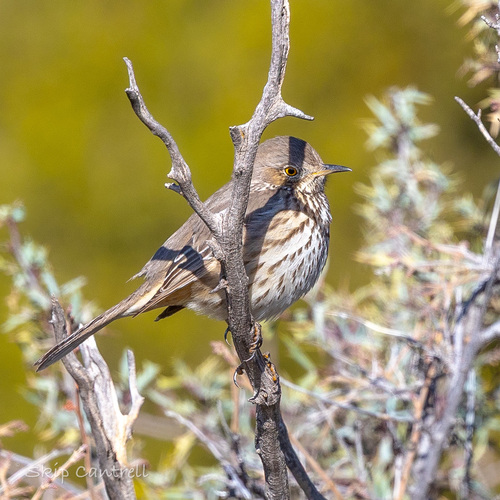
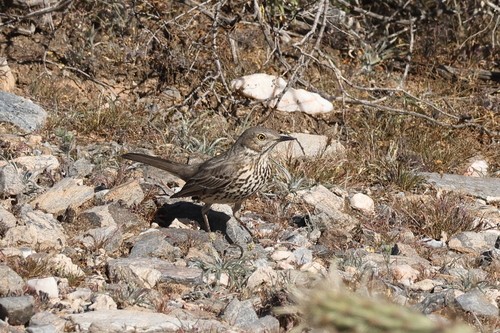
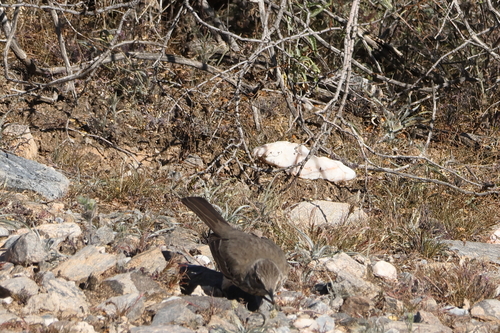
The sage thrasher is a medium-sized passerine, measuring 20.0-23.0 cm in length and weighing 39.6-50.3g. Its eyes are distinctive ranging from lemon-yellow to amber coloration. Juveniles have paler upperparts and lightly streaked underparts compare to the adults. Adults display brownish-gray upperparts and white underparts marked with dark streaks. Plumage remains relatively similar throughout the year. Sage thrasher can be distinguished from other thrashers by its shorter and less curved bill, shorter tail and smaller size. Voice: Sage thrashers sing to attract mates and establish territories. During migration to their breeding grounds, silent individuals travel ahead of occupied territories by others until they reach an unoccupied one, where they begin to sing they are established. Singing is most frequent during territory establishment and pair formation, and stop when nest building starts.
Text from Wikipedia, licensed CC BY-SA 4.0.
When to see the Sage Thrasher
One bar for each month. Filled bars are the 10 months with records; pale bars are months with none. The wide bar is June, the month with the most records.
Where to see the Sage Thrasher
The map shades 3 countries with regular records. Everything unshaded has no records. Countries are listed below the map.
About the Sage Thrasher
The sage thrasher is a medium-sized passerine bird in the family Mimidae. It is the only species in the genus Oreoscoptes and the smallest of the thrashers. It is found in the regions of western North America, breeding from the Great Basin to southern British Columbia, and migrates south to southern United States and northern Mexico for winter. Sage thrashers are commonly found in shrubsteppe habitat and are strongly associated with sagebrush for which it relies on for nesting.
Text adapted from Wikipedia, licensed CC BY-SA 4.0.
Easily confused with
 Long-billed ThrasherToxostoma longirostreThis bird is slender and long-tailed, averaging 26.5–29 cm (10.5–11.5 in) in length and about 70 g (2.5 oz) in weight.
 Crissal ThrasherToxostoma crissaleThe bird grows to 32 centimetres (13 in), and has a deeply curved bill.
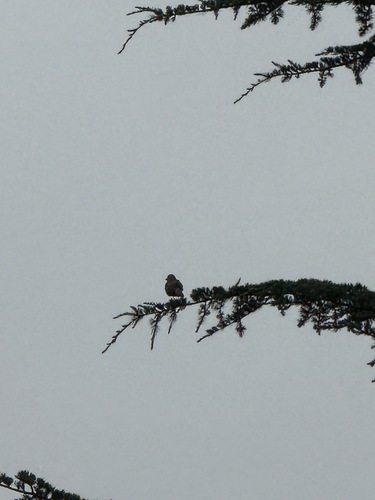 Chilean MockingbirdMimus thencaThe Chilean mockingbird is 28 to 29 cm (11.0 to 11.4 in) long and weighs 66 g (2.3 oz).
Side by side: Long-billed Thrasher vs Sage Thrasher · Crissal Thrasher vs Sage Thrasher · Chilean Mockingbird vs Sage Thrasher
Learn the Sage Thrasher in the BeakBrain App
Photo and call practice. Coming soon to iPhone and Android.
Play today's Daily BirdEvery photo and recording on this page is credited to its author under the licence shown. Spotted a problem with this page, or have a better photo? Contribute.