Learn what every symbol on the card means.Full credits and sources at beakbrain.com/symbols
 ShrublandTiny · 14 g
What the Saffron Siskin sounds like


ID tip
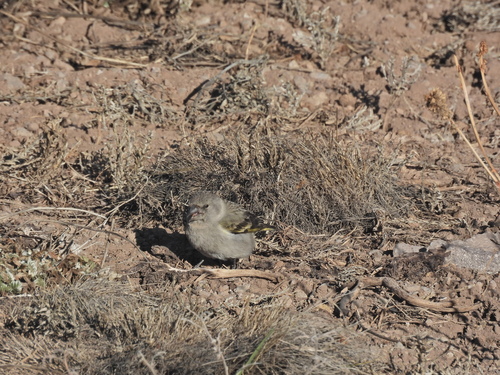
The saffron siskin grows to a length of about 10 to 10.5 cm (3.9 to 4.1 in). Like other siskins, the colours of this bird are black, olive and yellow, with black wings and a prominent yellow band on the bases of the flight feathers and another on the wing coverts. The male differs from the male hooded siskin (Spinus magellanicus) in having an unstreaked, golden-olive back and bright yellow underparts. The female differs from the female hooded siskin by being altogether yellower, with yellow underparts rather than grey.
Text from Wikipedia, licensed CC BY-SA 4.0.
When to see the Saffron Siskin
One bar for each month. Filled bars are the 11 months with records; pale bars are months with none. The wide bar is January, the month with the most records.
Where to see the Saffron Siskin
The map shades 1 country with regular records. Everything unshaded has no records. Countries are listed below the map.
About the Saffron Siskin
The saffron siskin is a species of finch in the family Fringillidae. It is found in Ecuador and Peru. Its natural habitats are subtropical or tropical dry forests, subtropical or tropical dry shrubland, and urban areas. It is threatened by habitat destruction and the IUCN has assessed it as being a "least concern species".
Text adapted from Wikipedia, licensed CC BY-SA 4.0.
Easily confused with
 Thick-billed SiskinSpinus crassirostrisThe thick-billed siskin is one of the larger members of genus Spinus and has the eponymous thick bill.
 Black-capped SiskinSpinus atricepsThe black-capped siskin is 11 to 13 cm (4.3 to 5.1 in) long.
 Antillean SiskinSpinus dominicensisThe Antillean siskin is 11 to 12 cm (4.3 to 4.7 in) long and weighs about 9 g (0.3 oz).
Learn the Saffron Siskin in the BeakBrain App
Photo and call practice. Coming soon to iPhone and Android.
Play today's Daily BirdEvery photo and recording on this page is credited to its author under the licence shown. Spotted a problem with this page, or have a better photo? Contribute.