Learn what every symbol on the card means.Full credits and sources at beakbrain.com/symbols
 ForestCup nestTiny · 13 g


ID tip
The Antillean siskin is 11 to 12 cm (4.3 to 4.7 in) long and weighs about 9 g (0.3 oz). The species is sexually dimorphic. Adult males have a black crown, face, and throat with a narrow bright yellow collar around their neck. Their lower nape, scapulars, and back are light olive-green and their rump and uppertail coverts a brighter olive-yellow. Their tail is mostly black with wide, deep yellow, edges at the bases of the outer feathers. Their wings have a complicated pattern. Their greater coverts are blackish brown with yellowish-olive edges and bright yellow tips. Voice: The Antillean siskin's vocalizations include a "soft chutchut", a "higher-pitched swee-ee" and a "low, bubbling trill".
Text from Wikipedia, licensed CC BY-SA 4.0.
When to see the Antillean Siskin
One bar for each month, and every month is filled: this bird is recorded here in all twelve. The wide bar is March, the month with the most records.
Where to see the Antillean Siskin
The map shades 2 countries with regular records. Everything unshaded has no records. Countries are listed below the map.
About the Antillean Siskin
The Antillean siskin is a species of bird in the family Fringillidae, the finches and euphonias. It is endemic to the island of Hispaniola that is shared by Haiti and the Dominican Republic.
Text adapted from Wikipedia, licensed CC BY-SA 4.0.
Easily confused with
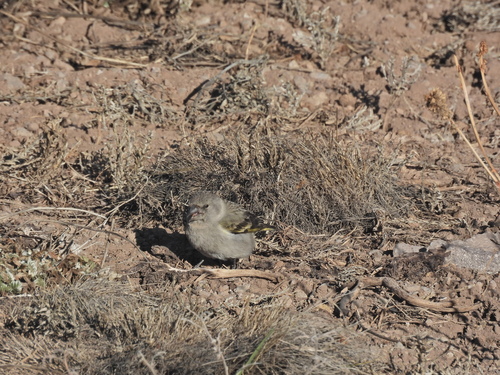 Thick-billed SiskinSpinus crassirostrisThe thick-billed siskin is one of the larger members of genus Spinus and has the eponymous thick bill.
 Saffron SiskinSpinus siemiradzkiiThe saffron siskin grows to a length of about 10 to 10.5 cm (3.9 to 4.1 in).
 Black-capped SiskinSpinus atricepsThe black-capped siskin is 11 to 13 cm (4.3 to 5.1 in) long.
Learn the Antillean Siskin in the BeakBrain App
Photo and call practice. Coming soon to iPhone and Android.
Play today's Daily BirdEvery photo and recording on this page is credited to its author under the licence shown. Spotted a problem with this page, or have a better photo? Contribute.