Learn what every symbol on the card means.Full credits and sources at beakbrain.com/symbols
 ShrublandDomed nestSmall · 46 g


What the Rufous Hornero sounds like

ID tip
The rufous hornero is a medium-sized ovenbird at 18 to 20 centimetres (7–8 in) and 31 to 58 grams (1.1–2.05 oz), with males being heavier. It has a slender and slightly decurved bill suited to eating insects, which is horn-coloured with a length of 2.5 centimetres (1.0 in). Wings length is 10.2 centimetres (4 in), with males generally being larger. The tail is short at 7.1 centimetres (2.8 in). The measurements of the species may differ due to the Bergmann's rule. The sexes have similar plumage. It has a rufous-brown back and pale buffy brown underparts.
Text from Wikipedia, licensed CC BY-SA 4.0.
When to see the Rufous Hornero
One bar for each month, and every month is filled: this bird is recorded here in all twelve. The wide bar is October, the month with the most records.
Where to see the Rufous Hornero
The map shades 5 countries with regular records. Everything unshaded has no records. Countries are listed below the map.
About the Rufous Hornero
The rufous hornero is a medium-sized ovenbird in the family Furnariidae. It occurs in eastern South America and is the national bird of Argentina. Also known as the red ovenbird, it is common in savannas, second-growth scrub, pastures, and agricultural land and is synanthropic. Its range includes midwestern, southeastern, and southern Brazil, Bolivia, Paraguay, Uruguay, and northern and central Argentina, extending as far south as northern Patagonia. The species is most closely related to the crested hornero of Paraguay and Argentina. There are four accepted subspecies.
Text adapted from Wikipedia, licensed CC BY-SA 4.0.
Easily confused with
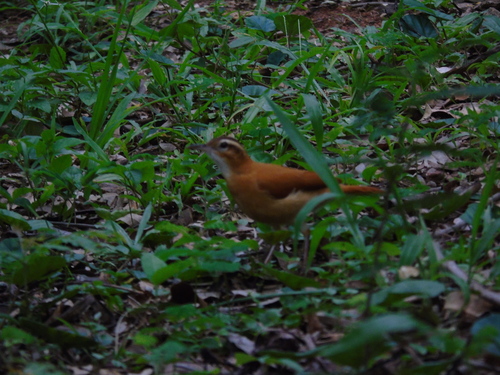 Pale-legged HorneroFurnarius leucopusThe pale-legged hornero is 15 to 18 cm (5.9 to 7.1 in) long and weighs about 37 to 49 g (1.3 to 1.7 oz).
 Band-tailed HorneroFurnarius figulusThe band-tailed hornero is 15 to 16 cm (5.9 to 6.3 in) long and weighs about 28 g (0.99 oz).
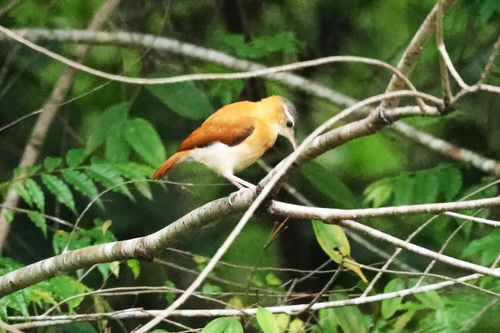 Caribbean HorneroFurnarius longirostrisThe Caribbean hornero is 17 to 19 cm (6.7 to 7.5 in) long.
Side by side: Pale-legged Hornero vs Rufous Hornero · Band-tailed Hornero vs Rufous Hornero
Learn the Rufous Hornero in the BeakBrain App
Photo and call practice. Coming soon to iPhone and Android.
Play today's Daily BirdEvery photo and recording on this page is credited to its author under the licence shown. Spotted a problem with this page, or have a better photo? Contribute.