Learn what every symbol on the card means.Full credits and sources at beakbrain.com/symbols
 ForestCavity nestSmall · 28 g


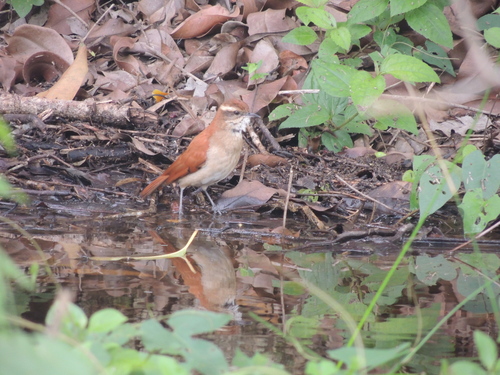


ID tip
The band-tailed hornero is 15 to 16 cm (5.9 to 6.3 in) long and weighs about 28 g (0.99 oz). It is a small hornero with a long and nearly straight bill. The sexes' plumages are alike. Adults of the nominate subspecies have a wide white supercilium, dingy rufous lores, a dark stripe through the eye, dull rufous ear coverts, and a tawny buff malar area. Their crown is chestnut-rufous and their back, rump, and uppertail coverts a slightly paler chestnut-rufous. Their tail is also chestnut-rufous, with brownish black tips on the inner webs of its feathers. Voice: The band-tailed hornero's song is a "series of 3-20 high, very loud staccato notes 'djip-djip--' " that decelerate and descend in pitch. One call is a "harsh 'djeep-djeep--' "; others are "chibit, chep" and "kwee-eh". Pairs often sing in duet.
Text from Wikipedia, licensed CC BY-SA 4.0.
When to see the Band-tailed Hornero
One bar for each month, and every month is filled: this bird is recorded here in all twelve. The wide bar is October, the month with the most records.
Where to see the Band-tailed Hornero
The map shades 1 country with regular records. Everything unshaded has no records. Countries are listed below the map.
About the Band-tailed Hornero
The band-tailed hornero, also known as wing-banded hornero, is a species of bird in the Furnariinae subfamily of the ovenbird family Furnariidae. It is endemic to Brazil.
Text adapted from Wikipedia, licensed CC BY-SA 4.0.
Easily confused with
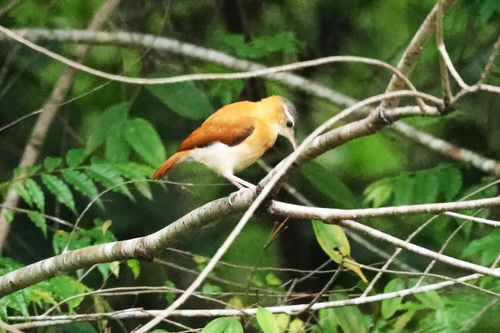 Caribbean HorneroFurnarius longirostrisThe Caribbean hornero is 17 to 19 cm (6.7 to 7.5 in) long.
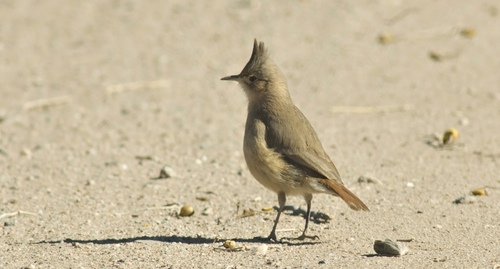 Crested HorneroFurnarius cristatusThe crested hornero is 14 to 15 cm (5.5 to 5.9 in) long and weighs 26 to 29 g (0.92 to 1.0 oz).
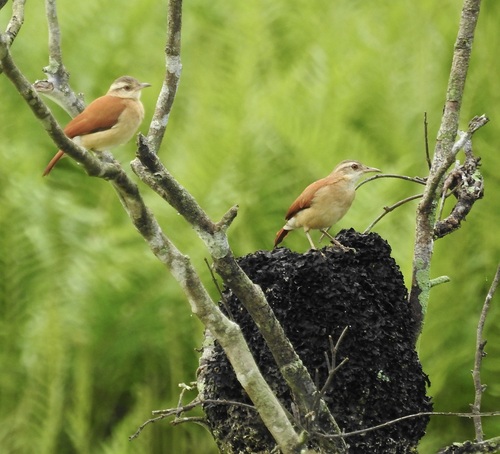 Lesser HorneroFurnarius minorThe lesser hornero is a species of bird in the ovenbird family Furnariidae.
Side by side: Band-tailed Hornero vs Rufous Hornero · Band-tailed Hornero vs Pale-legged Hornero · Band-tailed Hornero vs Lark-like Brushrunner · Band-tailed Hornero vs Crested Hornero
Learn the Band-tailed Hornero in the BeakBrain App
Photo and call practice. Coming soon to iPhone and Android.
Play today's Daily BirdEvery photo and recording on this page is credited to its author under the licence shown. Spotted a problem with this page, or have a better photo? Contribute.