Learn what every symbol on the card means.Full credits and sources at beakbrain.com/symbols
 WoodlandScrapeSmall · 52 g

ID tip
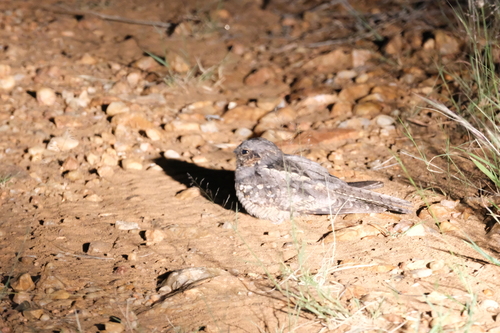
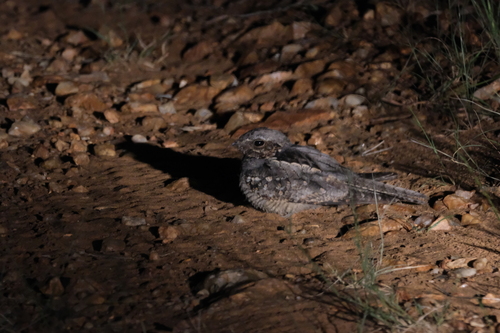
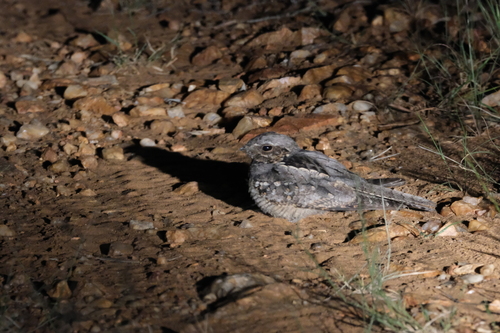
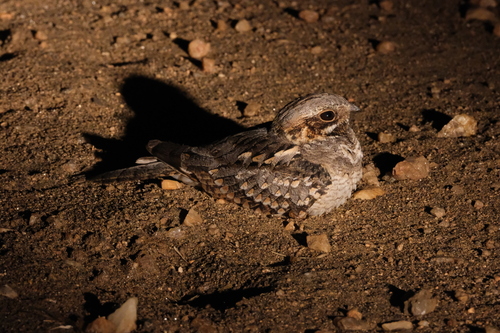
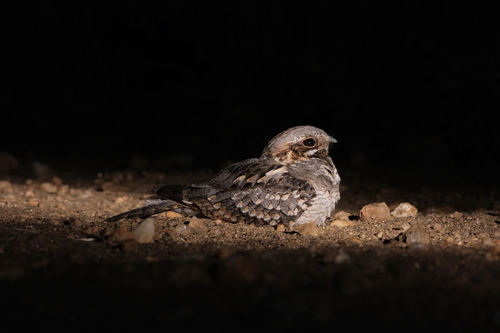
Similar to that of the fiery-necked nightjar, the rufous-cheeked nightjar is 23–24 cm tall with a male weighing 48-65g and a female weighing 46-66g, and has a typical nightjar body shape. Paler than the fiery-necked nightjar, the rufous-necked nightjar has a dark brown body decorated with rufous-coloured spots and a less distinct rufous-coloured collar. Like most nightjars, it has a short, slightly curved black beak. A male has white marks on the primaries and the tail corner, while in females it is buff. Voice: The rufous-cheeked nightjar has two main flight calls. One is an upbeat "Q! Q! Q! Q!" and the other is a harsh "oar! oar! oar!" they are sung with slight pauses. The nightjar also has a territoriality song, it starts with preliminary coughs "Q-whoop...Q-whoop...Q-whoop" with the "Q" in the cough being a softer version of the Q! flight call. Afterwards, the nightjar starts churring at 31 and 32–37.
Text from Wikipedia, licensed CC BY-SA 4.0.
When to see the Rufous-cheeked Nightjar
One bar for each month. Filled bars are the 7 months with records; pale bars are months with none. The wide bar is November, the month with the most records.
Where to see the Rufous-cheeked Nightjar
The map shades 8 countries with regular records. Everything unshaded has no records. Countries are listed below the map.
About the Rufous-cheeked Nightjar
The rufous-cheeked nightjar is a species of nightjar in the family Caprimulgidae. It is an intra-African migrant that breeds in the south of its range. It spends the non-breeding season in eastern Nigeria, Cameroon, southern Chad and Sudan, the Republic of the Congo, the D.R.C. and western Central African Republic. Throughout the year it can be found in Southern Africa. It is a nocturnal species that feeds on flying insects, mainly hunting at dusk and the early night. They can hunt at night thanks to their large eyes that are adept at seeing in the dark. They cannot see in complete darkness and most likely cannot see colours either.
Text adapted from Wikipedia, licensed CC BY-SA 4.0.
Easily confused with
 Grey NightjarCaprimulgus jotakaThe grey nightjar is a medium-sized nightjar with a large head, large eye, long tail, weak bill and short legs.
 Freckled NightjarCaprimulgus tristigmaThe freckled nightjar is a large, powerfully-build species of nightjar with long wings and relatively short tails.
 Jungle NightjarCaprimulgus indicusThe jungle nightjar is about 21–24 cm long with the Sri Lankan population (ssp. kelaarti) being smaller.
Side by side: Jungle Nightjar vs Rufous-cheeked Nightjar · Freckled Nightjar vs Rufous-cheeked Nightjar · Grey Nightjar vs Rufous-cheeked Nightjar
Learn the Rufous-cheeked Nightjar in the BeakBrain App
Photo and call practice. Coming soon to iPhone and Android.
Play today's Daily BirdEvery photo and recording on this page is credited to its author under the licence shown. Spotted a problem with this page, or have a better photo? Contribute.