Learn what every symbol on the card means.Full credits and sources at beakbrain.com/symbols
 ForestScrapeMedium · 92 g

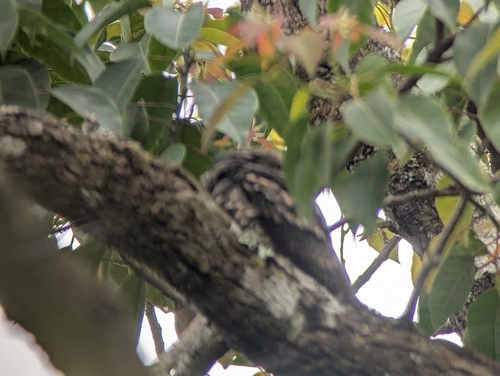
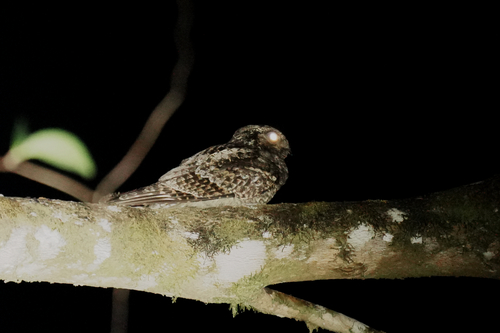
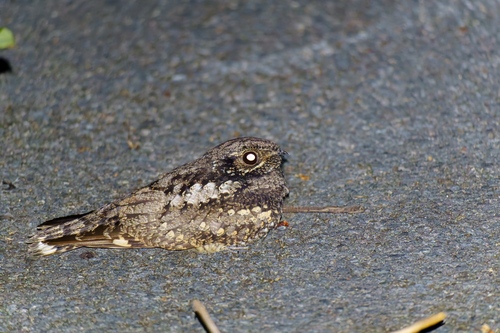
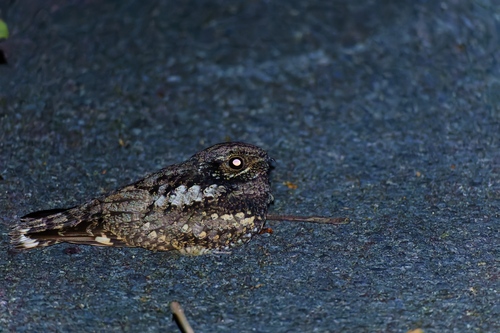
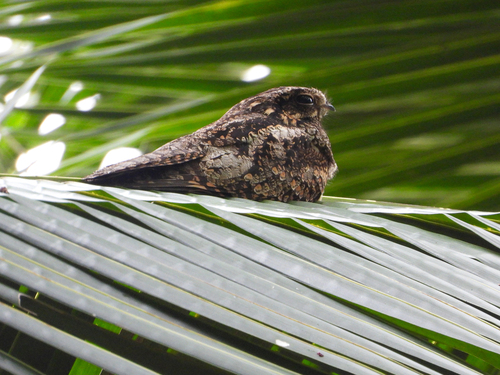
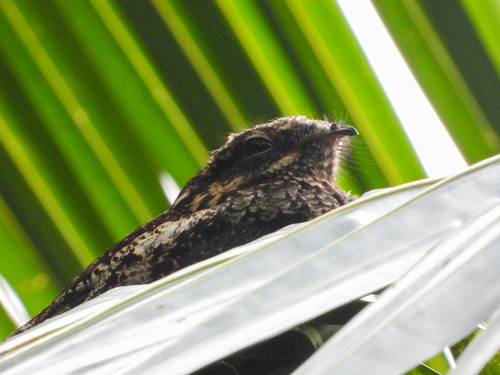
ID tip
The grey nightjar is a medium-sized nightjar with a large head, large eye, long tail, weak bill and short legs. The plumage is mottled, very similar to the Himalayas subspecies of jungle nightjar (C. indicus harzarae). The forehead, crown, and nape are covered with small, intricate grayish-white and dark brown vermiculated patterns mixed with black longitudinal streaks, with the central black stripe on the crown being particularly prominent. The feathers on the nape have pale brown spots at the tips. Voice: The vocalization of nightjars is an important aspect to distinguish them in field. The grey nightjar song is a series of hollow byuck notes lasting 2–4 seconds and repeated at short intervals, like the firing of a cartoon laser gun (click to hear).
Text from Wikipedia, licensed CC BY-SA 4.0.
When to see the Grey Nightjar
One bar for each month. Filled bars are the 9 months with records; pale bars are months with none. The wide bar is April, the month with the most records.
Where to see the Grey Nightjar
The map shades 21 countries with regular records. Everything unshaded has no records. Countries are listed below the map.
About the Grey Nightjar
The grey nightjar is a species of nightjar found in East Asia, breeding from southeastern Russia south through China, the Korean Peninsula and Japan to northern Indochina and westward along the Himalayas. It is largely migratory, wintering in Indochina south to Java in Indonesia, but is resident in warmer areas in the south of its breeding range. It is sometimes treated as a subspecies of the jungle nightjar, its South Asian relative. The grey nightjar breeds and forages in early successional habitats surrounded by forests; its populations have declined since the 1970s in Japan.
Text adapted from Wikipedia, licensed CC BY-SA 4.0.
Easily confused with
 Rufous-cheeked NightjarCaprimulgus rufigenaSimilar to that of the fiery-necked nightjar, the rufous-cheeked nightjar is 23–24 cm tall with a male weighing 48-65g and a female weighing 46-66g, and has a typical nightjar body shape.
 Freckled NightjarCaprimulgus tristigmaThe freckled nightjar is a large, powerfully-build species of nightjar with long wings and relatively short tails.
 Jungle NightjarCaprimulgus indicusThe jungle nightjar is about 21–24 cm long with the Sri Lankan population (ssp. kelaarti) being smaller.
Side by side: Grey Nightjar vs Rufous-cheeked Nightjar · Freckled Nightjar vs Grey Nightjar · Grey Nightjar vs Jungle Nightjar
Learn the Grey Nightjar in the BeakBrain App
Photo and call practice. Coming soon to iPhone and Android.
Play today's Daily BirdEvery photo and recording on this page is credited to its author under the licence shown. Spotted a problem with this page, or have a better photo? Contribute.