Learn what every symbol on the card means.Full credits and sources at beakbrain.com/symbols
 WetlandPlatform nestLarge · 1000 g


ID tip
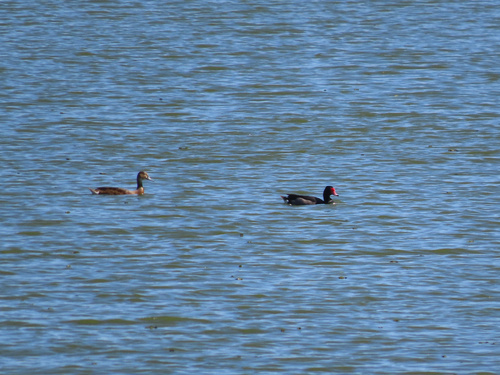
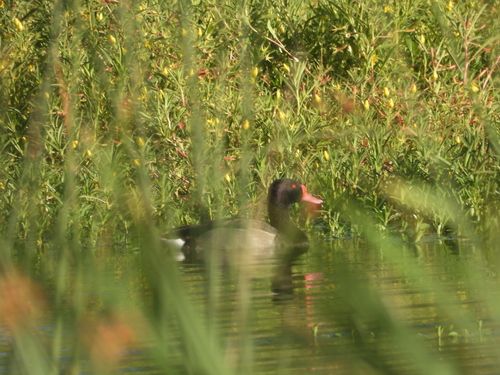
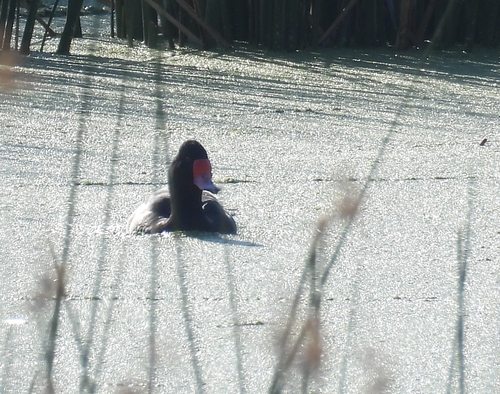
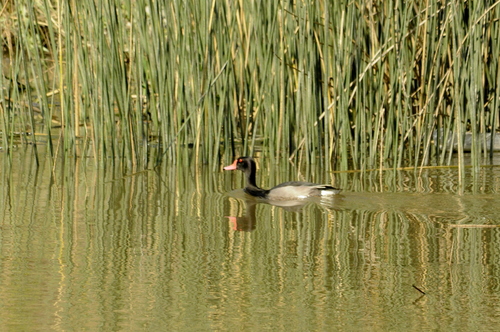
Like many other members of family Anatidae, the rosy-billed pochard exhibits significant sexual dimorphism. Males have a purplish-black head, neck and breast with gray sides, a white area on the crissum (the area around the cloaca), and a bright red bill and red eyes. The bill has a large rounded knob, which is bright red, and rest of the bill gradually fades towards a pale pink before ending with a black tip. The rounded knob of the bill increases in size and intensity in colour during the mating season. Voice: Similar to almost all other bird species, rosybills have different calls used for different purposes. The characteristic 'honk' of family Anatidae is obvious in this pochard's vocalization, however it is much deeper as compared to a mallard, for example. Based on limited recordings of vocalizations, it appears as if the vocalization of the rosey-billed pochard is relatively quiet.
Text from Wikipedia, licensed CC BY-SA 4.0.
When to see the Rosy-billed Pochard
One bar for each month, and every month is filled: this bird is recorded here in all twelve. The wide bar is October, the month with the most records.
Where to see the Rosy-billed Pochard
The map shades 10 countries with regular records, and 8 more in a lighter tone where the bird turns up only as a stray. Everything unshaded has no records. Countries are listed below the map.
Recorded as a rare visitor in France, United States, United Kingdom, Germany, Spain, Belgium, Italy, Portugal.
About the Rosy-billed Pochard
The rosy-billed pochard, alternatively named rosybill or rosybill pochard, is a member of family Anatidae. Though classified as a diving duck, this pochard feeds more like a dabbling duck feeding on seeds roots, sedges, aquatic plants and other grasses. Netta is Ancient Greek for "duck" and peposaca is a transcription of the Guaraní name of this species which means "showy wings", referring to the broad white stripe that is only visible with stretched out wings. Male characteristic features include a bright red bill with a rounded knob at the base.
Text adapted from Wikipedia, licensed CC BY-SA 4.0.
Easily confused with
 Southern PochardNetta erythrophthalmaThe southern pochard is a species of duck, and a member of the genus Netta.
 Red-crested PochardNetta rufinaThe red-crested pochard is a large diving duck.
Side by side: Radjah Shelduck vs Rosy-billed Pochard
Learn the Rosy-billed Pochard in the BeakBrain App
Photo and call practice. Coming soon to iPhone and Android.
Play today's Daily BirdEvery photo and recording on this page is credited to its author under the licence shown. Spotted a problem with this page, or have a better photo? Contribute.