Learn what every symbol on the card means.Full credits and sources at beakbrain.com/symbols
 WoodlandCavity nestSmall · 50 g


ID tip
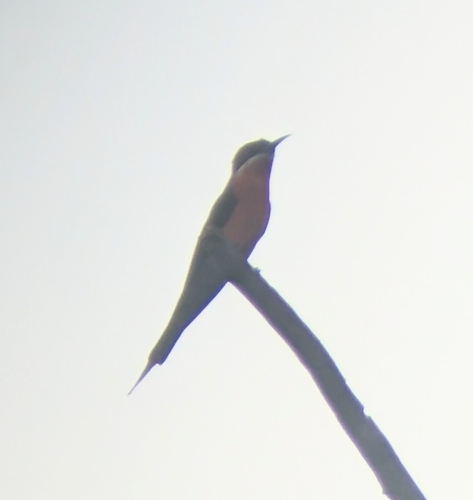
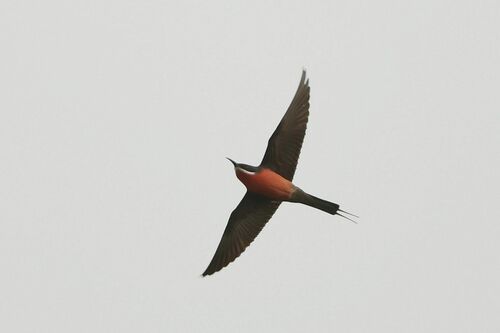
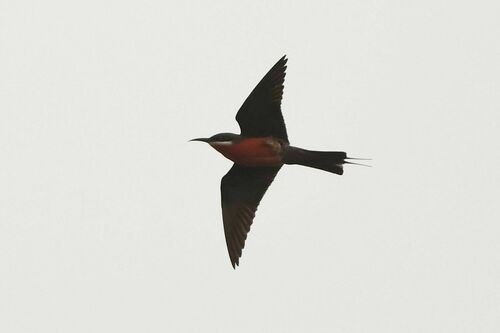
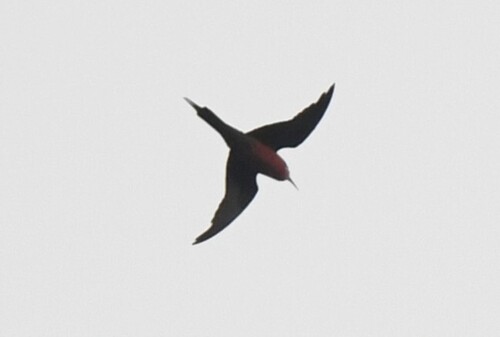
The adult is a distinctively colored bird that grows to a length of 22 to 25 cm (9 to 10 in) with tail-streamers adding 5 cm (2 in) to this, and weighing about 45 g (1.6 oz). Both sexes have similar features. The forehead and crown are dark grey, the mask black and the chin and cheek are white. The mantle is black, the wings and back are slate-grey and the rump paler grey. The tail is carmine, gradually bleaching to grey. The throat and underparts are bright pink and the undertail coverts are grey. The undersides of the flight feathers and large tail feathers are glossy black.
Text from Wikipedia, licensed CC BY-SA 4.0.
When to see the Rosy Bee-eater
One bar for each month. Filled bars are the 9 months with records; pale bars are months with none. The wide bar is March, the month with the most records.
Where to see the Rosy Bee-eater
The map shades 6 countries with regular records, and 2 more in a lighter tone where the bird turns up only as a stray. Everything unshaded has no records. Countries are listed below the map.
Recorded as a rare visitor in Equatorial Guinea, Togo.
About the Rosy Bee-eater
The rosy bee-eater is a species of bird in the family Meropidae. It is found in Angola, Benin, Burkina Faso, Republic of the Congo, Democratic Republic of the Congo, Ivory Coast, Equatorial Guinea, Gabon, Ghana, Nigeria, and Togo.
Text adapted from Wikipedia, licensed CC BY-SA 4.0.
Easily confused with
 Böhm's Bee-eaterMerops boehmiBöhm's bee-eater is a species of bird in the family Meropidae.
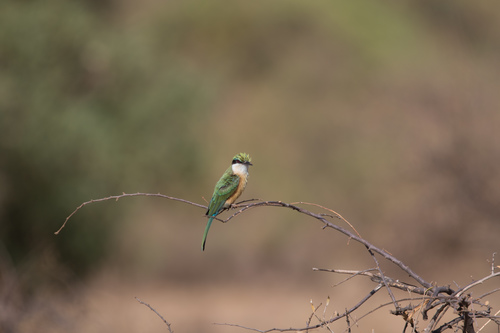 Somali Bee-eaterMerops revoiliiThe Somali bee-eater grows to a length of 16 to 18 cm (6.3 to 7.1 in) and is the smallest member of the genus.
 Blue-headed Bee-eaterMerops muelleriThe sexes are similar and the length of the adult is about 19 cm (7.5 in).
Learn the Rosy Bee-eater in the BeakBrain App
Photo and call practice. Coming soon to iPhone and Android.
Play today's Daily BirdEvery photo and recording on this page is credited to its author under the licence shown. Spotted a problem with this page, or have a better photo? Contribute.