Learn what every symbol on the card means.Full credits and sources at beakbrain.com/symbols
 ForestCavity nestSmall · 23 g
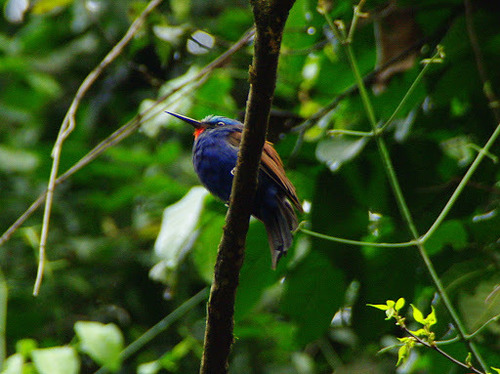
ID tip
The sexes are similar and the length of the adult is about 19 cm (7.5 in). The back and wings are dark brown while the remaining plumage is mostly ultramarine blue. The crown of birds living in the east of the range is blue fading to white on the forehead; western populations have entirely blue heads. The chin and upper throat is scarlet, with a black margin. The belly is a paler shade of blue. The eye is red. In the poor light in the interior of the forest, this bird can be confused with the black bee-eater (Merops gularis).
Text from Wikipedia, licensed CC BY-SA 4.0.
When to see the Blue-headed Bee-eater
One bar for each month, and every month is filled: this bird is recorded here in all twelve. The wide bar is November, the month with the most records.
Where to see the Blue-headed Bee-eater
The map shades 6 countries with regular records, and 2 more in a lighter tone where the bird turns up only as a stray. Everything unshaded has no records. Countries are listed below the map.
Recorded as a rare visitor in Central African Republic, Guinea.
About the Blue-headed Bee-eater
The blue-headed bee-eater is a species of bird in the family Meropidae. It is found in forest habitats in tropical West and Central Africa, including in Cameroon, Central African Republic, Republic of the Congo, Democratic Republic of the Congo, Gabon, Equatorial Guinea, and Kenya.
Text adapted from Wikipedia, licensed CC BY-SA 4.0.
Easily confused with
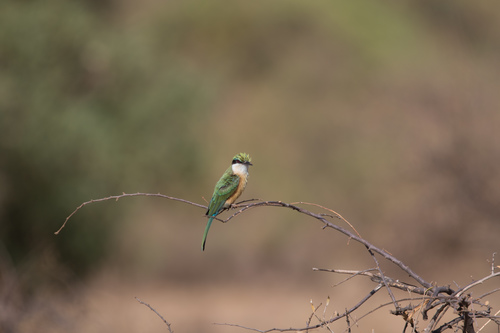 Somali Bee-eaterMerops revoiliiThe Somali bee-eater grows to a length of 16 to 18 cm (6.3 to 7.1 in) and is the smallest member of the genus.
Blue-moustached Bee-eaterMerops mentalisThe blue-moustached bee-eater measures about 19 cm in length with tail streamers up to 3 cm more.
Somali Bee-eaterMerops revoiliiThe Somali bee-eater grows to a length of 16 to 18 cm (6.3 to 7.1 in) and is the smallest member of the genus.
Blue-moustached Bee-eaterMerops mentalisThe blue-moustached bee-eater measures about 19 cm in length with tail streamers up to 3 cm more.
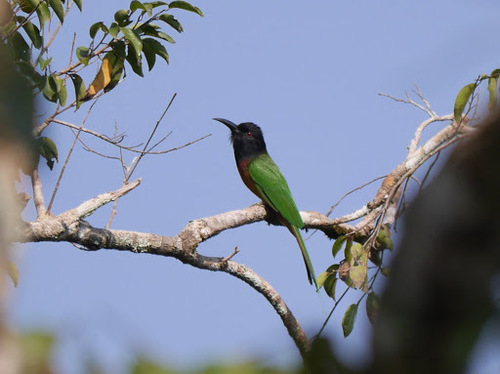 Black-headed Bee-eaterMerops breweriThe adult black-headed bee-eater is between 25 and 28 cm (10 and 11 in) in length, excluding the 8 cm (3 in) tail streamers.
Learn the Blue-headed Bee-eater in the BeakBrain App
Photo and call practice. Coming soon to iPhone and Android.
Play today's Daily BirdEvery photo and recording on this page is credited to its author under the licence shown. Spotted a problem with this page, or have a better photo? Contribute.