Learn what every symbol on the card means.Full credits and sources at beakbrain.com/symbols
 ForestCavity nestSmall · 50 g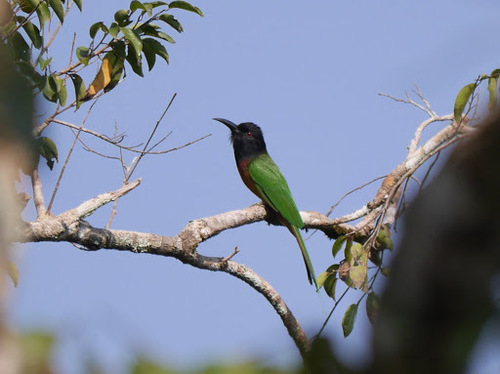
ID tip
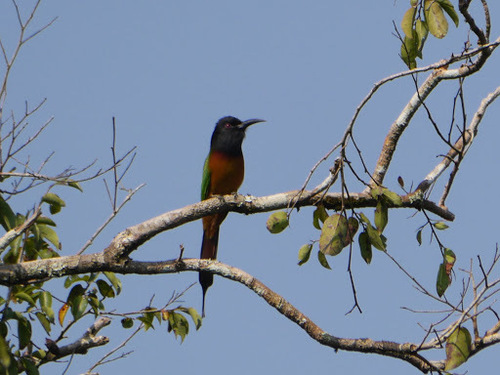
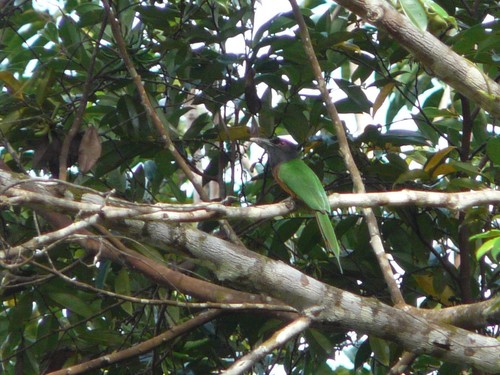
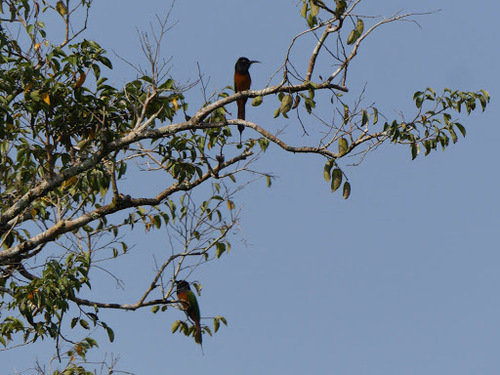
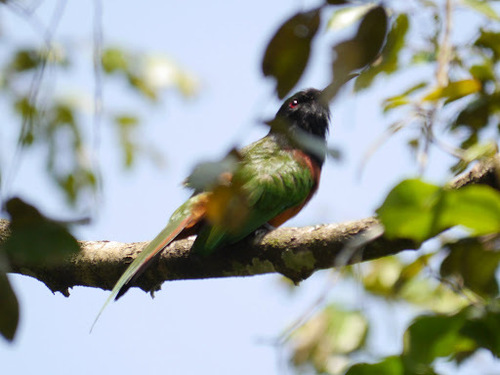
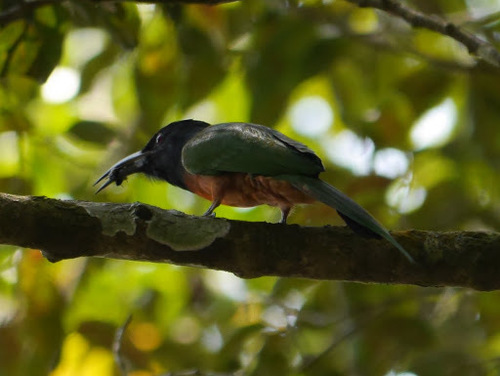
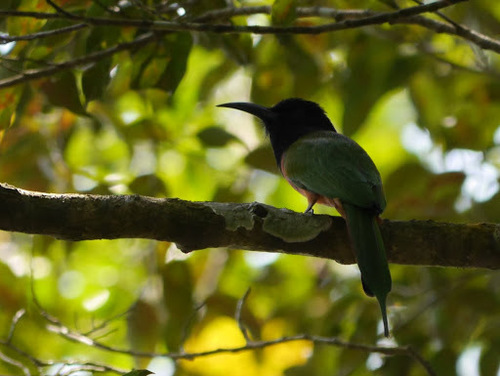
The adult black-headed bee-eater is between 25 and 28 cm (10 and 11 in) in length, excluding the 8 cm (3 in) tail streamers. The sexes are similar and it is a distinctive bird with a black head, green back, wings and tail, and buff breast and belly, with a rufous band across the lower breast. The juvenile has a black chin and throat. The only other bee-eaters living in forests within its range are the black bee-eater (Merops gularis) and the blue-headed bee-eater (Merops muelleri), and these have different colourings and are considerably smaller.
Text from Wikipedia, licensed CC BY-SA 4.0.
When to see the Black-headed Bee-eater
One bar for each month. Filled bars are the 10 months with records; pale bars are months with none. The wide bar is September, the month with the most records.
Where to see the Black-headed Bee-eater
The map shades 5 countries with regular records, and 2 more in a lighter tone where the bird turns up only as a stray. Everything unshaded has no records. Countries are listed below the map.
About the Black-headed Bee-eater
The black-headed bee-eater is a species of bird in the family Meropidae. It is found in forests in tropical Central and West Africa, its range including Angola, Central African Republic, Republic of the Congo, Democratic Republic of the Congo, Ivory Coast, Gabon, Ghana, Nigeria, and South Sudan.
Text adapted from Wikipedia, licensed CC BY-SA 4.0.
Easily confused with
 Blue-moustached Bee-eaterMerops mentalisThe blue-moustached bee-eater measures about 19 cm in length with tail streamers up to 3 cm more.
Blue-headed Bee-eaterMerops muelleriThe sexes are similar and the length of the adult is about 19 cm (7.5 in).
Blue-moustached Bee-eaterMerops mentalisThe blue-moustached bee-eater measures about 19 cm in length with tail streamers up to 3 cm more.
Blue-headed Bee-eaterMerops muelleriThe sexes are similar and the length of the adult is about 19 cm (7.5 in).
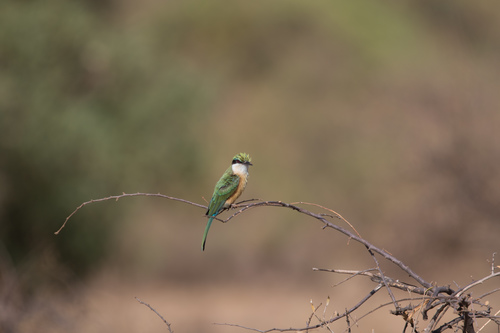 Somali Bee-eaterMerops revoiliiThe Somali bee-eater grows to a length of 16 to 18 cm (6.3 to 7.1 in) and is the smallest member of the genus.
Learn the Black-headed Bee-eater in the BeakBrain App
Photo and call practice. Coming soon to iPhone and Android.
Play today's Daily BirdEvery photo and recording on this page is credited to its author under the licence shown. Spotted a problem with this page, or have a better photo? Contribute.